Modafinil vs Other Stimulants: Where It Fits
 Written by Dr. Marcus Bennett · · Fact-checked November 2026 · How we review
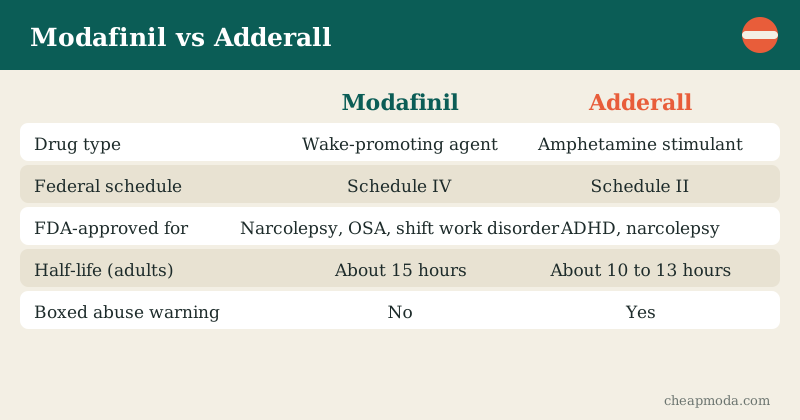
People often lump modafinil in with Adderall and Ritalin. That's understandable, since they all help people stay awake and alert. But modafinil is a different kind of drug, approved for different reasons and regulated differently. If you're trying to understand where it fits, the fastest way is to put it side by side with everything else people compare it to.
This guide compares modafinil (brand Provigil) with amphetamines such as Adderall and Vyvanse, methylphenidate (Ritalin), caffeine, armodafinil (Nuvigil), solriamfetol (Sunosi) and pitolisant (Wakix). It's based on the US prescribing information for each drug and on federal scheduling, not personal testing. It's general information, not medical advice, and it isn't a guide to choosing or switching medicines. That's a conversation for your prescriber. We earn a commission if you buy through our Afinil links, at no extra cost to you.
The quick answer
- Modafinil is a wakefulness-promoting agent, Schedule IV, approved for narcolepsy, obstructive sleep apnea (OSA) and shift work disorder.
- Adderall, Vyvanse and Ritalin are classic stimulants, Schedule II, mainly approved for ADHD. Adderall and Ritalin are also approved for narcolepsy.
- Caffeine is an over-the-counter alertness aid with no prescription needed.
- Armodafinil is modafinil's close cousin with the same uses and schedule.
- Sunosi and Wakix are newer prescription options for daytime sleepiness, and Wakix isn't a controlled substance at all.
[IMG1]
Is modafinil actually a stimulant?
The honest answer is "sort of." The Provigil label says the way modafinil promotes wakefulness isn't fully understood. It also says modafinil binds to the dopamine transporter and blocks dopamine reuptake, which raises dopamine levels in parts of the brain. Some classic stimulants act on that same transporter.
What's different is how strongly and broadly it acts, and how that shows up in practice. That's why the drug is usually called a wakefulness-promoting agent, and why the Drug Enforcement Administration placed it in Schedule IV rather than Schedule II with amphetamines and methylphenidate. Schedule IV still means it has abuse potential. The label says modafinil can produce psychoactive and euphoric effects and changes in mood and perception, so a lower schedule isn't the same as no risk.
Comparison table
Here's the big picture. Half-lives and approved uses come from the US labels; your prescriber's choice depends on far more than this table.
| Drug | Type | Federal schedule | Main FDA-approved uses | Typical dosing pattern |
|---|---|---|---|---|
| Modafinil (Provigil) | Wake-promoting agent | IV | Narcolepsy, OSA, shift work disorder | Once daily in the morning, or about an hour before a night shift |
| Armodafinil (Nuvigil) | Wake-promoting agent | IV | Same as modafinil | Once daily |
| Adderall | Amphetamine stimulant | II | ADHD, narcolepsy | One to three times daily (immediate release) |
| Vyvanse | Amphetamine prodrug | II | ADHD, binge eating disorder | Once daily |
| Ritalin | Methylphenidate stimulant | II | ADHD, narcolepsy | Two to three times daily (immediate release) |
| Sunosi | Dopamine and norepinephrine reuptake inhibitor | IV | Daytime sleepiness in narcolepsy or OSA | Once daily |
| Wakix | Histamine-3 receptor drug | Not controlled | Daytime sleepiness or cataplexy in narcolepsy | Once daily |
| Caffeine | Stimulant | Not controlled, OTC | Temporary alertness aid | 100 to 200 mg, no more than every 3 to 4 hours |
Modafinil vs amphetamines (Adderall and Vyvanse)
Adderall is a mix of amphetamine salts. It's approved for ADHD and narcolepsy, and it carries a boxed warning about abuse, misuse and addiction. Vyvanse (lisdexamfetamine) turns into amphetamine in the body and is approved for ADHD and binge eating disorder, not narcolepsy. Both are Schedule II, which means no refills: each fill needs a new prescription.
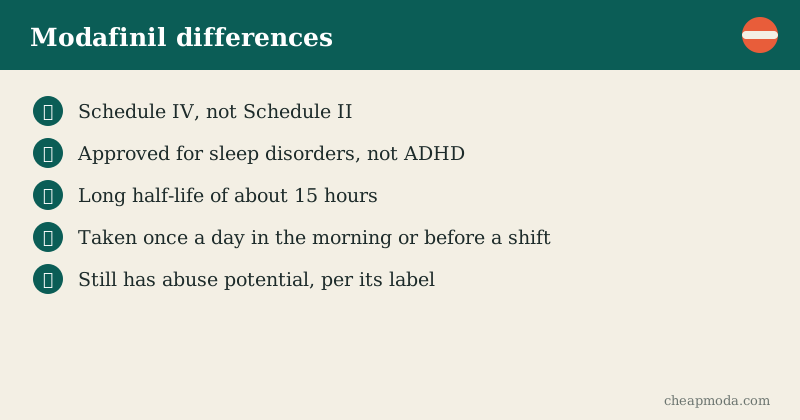
Modafinil isn't approved for ADHD. It's approved for sleepiness from three sleep disorders. As a Schedule IV drug, it can be refilled up to five times within six months if your prescriber allows it, under federal rules.
On duration, the Provigil label gives modafinil an elimination half-life of about 15 hours. The Adderall XR label lists amphetamine half-lives in adults of about 10 hours for the d-form and 13 hours for the l-form. In everyday terms, both can affect sleep if taken late in the day. For a deeper look at studying specifically, see our modafinil vs Adderall for studying guide.
Modafinil vs methylphenidate (Ritalin)
Methylphenidate is the drug in Ritalin, Concerta and several other brands. Ritalin is approved for ADHD and narcolepsy, and like Adderall it's Schedule II with a boxed warning about abuse and dependence. Immediate-release Ritalin wears off within a few hours, which is why it's often taken two or three times a day. Long-acting forms such as Concerta last much longer.
So the main contrasts are the same as with Adderall: a higher schedule, an ADHD focus and shorter-acting basic forms, against modafinil's once-a-day dosing and sleep-disorder approvals.
Modafinil vs caffeine
Caffeine is the stimulant almost everyone already uses. The FDA's over-the-counter rules allow caffeine tablets as an alertness aid at 100 to 200 mg, no more often than every three to four hours. The FDA has also said that about 400 mg a day is generally not linked to negative effects in healthy adults, though people differ a lot in how they handle it.
Caffeine is cheap, legal and quick to wear off. It isn't a treatment for narcolepsy, OSA or shift work disorder, and it can't stand in for one. Modafinil is a prescription drug meant for those diagnosed conditions. If coffee is what you're comparing, our modafinil vs coffee article goes into how people describe the difference.
Modafinil vs armodafinil (Nuvigil)
Armodafinil isn't really "another stimulant." It's one half of the modafinil molecule, the R-form, which stays in the body a bit longer. Its label lists a half-life of about 15 hours as well, and its approved uses are the same three sleep disorders. Both are Schedule IV. Our Nuvigil vs Provigil comparison covers dose strengths and practical differences.
Modafinil vs Sunosi and Wakix
These two are newer options for daytime sleepiness.
- Sunosi (solriamfetol) blocks reuptake of dopamine and norepinephrine. It's approved for excessive daytime sleepiness in adults with narcolepsy or OSA, and it's Schedule IV like modafinil.
- Wakix (pitolisant) works on histamine-3 receptors in the brain. It's approved for daytime sleepiness or cataplexy in adults with narcolepsy, and it isn't a controlled substance.
Both are brand-name drugs, and both are typically much more expensive than generic modafinil. For a closer look at one of them, see Sunosi vs Nuvigil.
Why the federal schedule matters to you
The schedule isn't just a label. It changes how you get the drug:
- Schedule II (Adderall, Vyvanse, Ritalin): no refills on a prescription, tighter rules on how much can be prescribed at once, and closer tracking.
- Schedule IV (modafinil, armodafinil, Sunosi): up to five refills within six months under federal rules, if your prescriber allows it.
- Not controlled (Wakix, caffeine): standard prescription rules for Wakix, and none at all for caffeine.
State rules and insurance limits can be stricter than federal ones. Every controlled prescription in the US also gets logged in your state's prescription monitoring program.
What the labels say about side effects
We're not going to rank these drugs by safety, because that depends on the person. But a few label facts are useful context:
- Modafinil: headache is the most common side effect, followed by nausea, nervousness, runny nose, back pain, diarrhea, anxiety, insomnia and dizziness. Rare severe rashes and psychiatric symptoms are listed as serious warnings. It can make hormonal birth control less effective.
- Amphetamines and methylphenidate: boxed warnings about abuse, misuse and addiction, plus warnings about effects on heart rate, blood pressure and mood.
- Caffeine: too much can cause jitteriness, a fast heartbeat and trouble sleeping.
If you take other medicines or have heart, liver, kidney or mental health conditions, these choices really are for your prescriber to make. Read our medical disclaimer for more.
Who each option is usually for
This isn't advice, just a summary of how the labels line up:
- Diagnosed narcolepsy: modafinil, armodafinil, Sunosi, Wakix, and some classic stimulants are all on the table. Sleep specialists choose based on symptoms, other health issues and cost. Our modafinil for sleep disorders guide covers how it's used there.
- Sleepiness with OSA on CPAP: modafinil, armodafinil and Sunosi are approved for leftover sleepiness.
- Shift work disorder: modafinil and armodafinil are the approved options.
- ADHD: classic stimulants and some non-stimulant ADHD drugs are the approved route. Modafinil isn't approved for ADHD.
- Everyday tiredness: caffeine, sleep and a check-up. If tiredness is constant, a doctor visit can rule out a sleep disorder.
Cost differences in broad strokes
Generic modafinil, generic armodafinil, generic Adderall and generic methylphenidate are all available in the US, and with insurance or a discount card they're often far cheaper than brand-only drugs like Sunosi and Wakix. Prices change by pharmacy, plan and dose, so ask your pharmacist for a quote before filling.
If you already have a modafinil prescription and you're comparing cash options, Afinil sells generic modafinil brands such as ModaXL. Keep in mind that these aren't FDA-approved products, and that in the US buying modafinil without a valid prescription or importing it isn't a legal route, even if a store labels it OTC. Our ModaXL 200 mg review and Afinil vendor review cover the store, and is buying modafinil legal covers the law.
Common myths
- "Modafinil isn't a controlled drug." It is. It's Schedule IV in the US.
- "Modafinil is just a weaker Adderall." They're approved for different conditions and work differently. "Weaker" doesn't describe the difference well.
- "No abuse potential." The label says modafinil can produce euphoric effects and has abuse potential, even if it's assessed as lower than Schedule II drugs.
- "Caffeine and modafinil do the same thing." Both increase alertness, but caffeine is a short-acting OTC aid and modafinil is a long-acting prescription drug for sleep disorders.
Verdict
Modafinil sits in its own lane. It's less tightly controlled than Adderall, Vyvanse or Ritalin, lasts a long time from a single morning dose, and is approved for sleep disorders rather than ADHD. Caffeine is the everyday option, armodafinil is its near twin, and Sunosi and Wakix are newer prescription alternatives for daytime sleepiness. Which one makes sense depends on your diagnosis and health history, so bring this comparison to your prescriber rather than using it to pick on your own.
FAQ
Is modafinil a stimulant?
It's usually described as a wakefulness-promoting agent rather than a classic stimulant. Its label says it works on the dopamine transporter, like some stimulants do, but how it promotes wakefulness isn't fully understood. It's Schedule IV, a lower federal category than Adderall or Ritalin.
Is modafinil stronger than Adderall?
They aren't directly comparable. They're approved for different conditions and work differently. Adderall is a Schedule II amphetamine for ADHD and narcolepsy, while modafinil is a Schedule IV drug for narcolepsy, sleep apnea and shift work disorder.
Is modafinil safer than other stimulants?
Every one of these drugs has risks listed on its label. Modafinil sits in a lower controlled-substance schedule than amphetamines and methylphenidate, which reflects a lower assessed abuse potential, but its label still warns about rare serious rashes and psychiatric symptoms.
Is modafinil approved for ADHD?
No. In the US, modafinil is FDA-approved only for excessive sleepiness from narcolepsy, obstructive sleep apnea and shift work disorder. Any use for ADHD is off-label.
How does modafinil compare to caffeine?
Caffeine is an over-the-counter alertness aid, and the FDA's OTC rules allow 100 to 200 mg no more often than every three to four hours. Modafinil is a prescription-only controlled drug that lasts much longer and is meant for diagnosed sleep disorders.
What are non-stimulant alternatives to modafinil?
Wakix (pitolisant) is an FDA-approved, non-controlled option for daytime sleepiness in narcolepsy. Sunosi (solriamfetol) is another option for narcolepsy and sleep apnea, though it's Schedule IV like modafinil. Your prescriber can say which fits.
Can you buy modafinil without a prescription like caffeine?
No. In the US modafinil is a Schedule IV controlled substance and needs a valid prescription. Importing it without one isn't a legal route, even if a website calls it OTC.