Sunosi vs Nuvigil: The Reddit Questions, Answered Properly
 Written by Dr. Marcus Bennett · · Fact-checked October 2026 · How we review
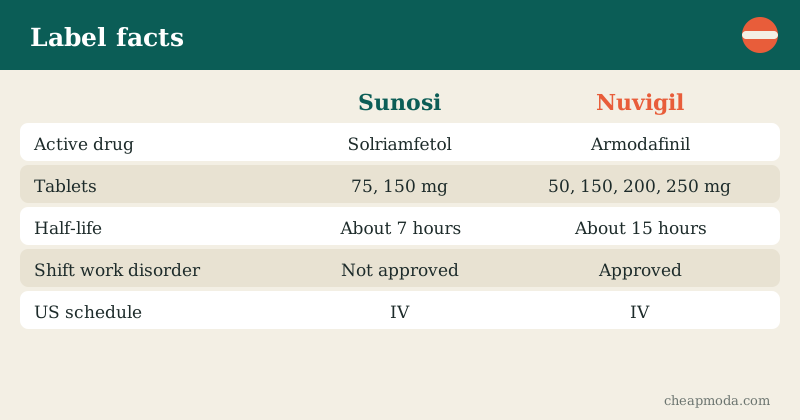
Search "Sunosi vs Nuvigil" and the results are full of forum threads. Someone has tried one, someone else swears by the other, and a third person says neither touched their sleepiness. Those personal stories are interesting, but they can't tell you how the two drugs actually differ. The official US prescribing information can, so that's what we've used here. We're not doctors and nothing on this page should replace a conversation with the person who prescribes your medicine.
We earn a commission if you buy through our links, at no extra cost to you. Afinil sells generic armodafinil (the drug in Nuvigil) but not Sunosi, so keep that in mind as you read.
The one-paragraph version
Sunosi (solriamfetol) and Nuvigil (armodafinil) are both prescription medicines that improve wakefulness in adults with excessive sleepiness. Sunosi was approved in the US in 2019; Nuvigil was approved in 2007. Sunosi clears from the body roughly twice as fast, has a tighter list of approved uses (narcolepsy and obstructive sleep apnea only) and carries a stronger blood pressure warning. Nuvigil lasts longer, also covers shift work disorder and carries warnings about serious rash and allergic reactions. Both are Schedule IV in the US.
Two different molecules, not two versions of one drug
A common forum assumption is that Sunosi is "a newer Nuvigil." It isn't.
Nuvigil contains armodafinil, the R-form of modafinil (the drug in Provigil). It's a close relative of modafinil, and the label says its wake-promoting mechanism is unknown, although it binds to the dopamine transporter and blocks dopamine reuptake in lab studies.
Sunosi contains solriamfetol, which is chemically unrelated to modafinil. Its label describes it as a dopamine and norepinephrine reuptake inhibitor (DNRI), while also saying the exact way it improves wakefulness is unclear. It has low affinity for those transporters and no meaningful action on serotonin.
So these are two separate families. Having a rash on one tells you nothing about the other in terms of cross-reaction, and doing poorly on one doesn't predict how you'll do on the other. That's partly why doctors sometimes try one after the other.
What each is approved for
| Condition (adults) | Sunosi | Nuvigil |
|---|---|---|
| Narcolepsy | Yes | Yes |
| Obstructive sleep apnea (OSA) | Yes | Yes |
| Shift work disorder | No | Yes |
| Children | Not established | Not approved |
For OSA, both labels say the drug treats the sleepiness, not the blocked airway. Sunosi's label goes further: it says the airway problem should be treated (for example with CPAP) for at least a month before starting, and that CPAP should continue. Nuvigil's label also asks for a real effort with CPAP first.
If you work night shifts and your sleepiness comes from shift work disorder, only Nuvigil (and Provigil) carry that use on their US labels.
Doses and timing
| Sunosi | Nuvigil | |
|---|---|---|
| Starting dose, narcolepsy | 75 mg once daily | 150 mg to 250 mg once in the morning |
| Starting dose, OSA | 37.5 mg once daily (half a scored 75 mg tablet) | 150 mg to 250 mg once in the morning |
| Shift work disorder | Not approved | 150 mg about 1 hour before the shift |
| Maximum on the label | 150 mg once daily | Up to 250 mg tolerated in OSA, with no consistent extra benefit over 150 mg |
| Timing rule | On waking; avoid within 9 hours of bedtime | Morning, or 1 hour before a shift |
| Dose changes | May be doubled no sooner than every 3 days | Set by the prescriber |
Sunosi's label is unusually specific about titration. It starts low and can step up, and it says doses above 150 mg don't add enough benefit to outweigh dose-related side effects. Nuvigil generally starts at a working dose.
Kidney function matters a lot for Sunosi, because about 95% of a dose leaves the body unchanged in urine. The label cuts the dose for moderate and severe kidney impairment and doesn't recommend it in end-stage kidney disease. Nuvigil's label adjusts for severe liver impairment instead, because armodafinil is mainly cleared by the liver.
How long each one lasts
This is the difference people notice most.
- Sunosi: peak level about 2 hours after a dose (taken fasting), and an elimination half-life of about 7.1 hours. Steady state comes after about 3 days.
- Nuvigil: peak level about 2 hours after a dose fasting, but food can push that back by 2 to 4 hours. The half-life is about 15 hours, and steady state takes up to 7 days.
What does that mean day to day? As a made-up example, if someone takes either drug at 7 AM, by 9 PM about two half-lives of Sunosi have passed, so roughly a quarter of the peak amount remains. With Nuvigil, less than one half-life has passed, so more than half remains. That's why Sunosi's label says to keep doses 9 hours away from bedtime, and why some Nuvigil users report trouble falling asleep. Your own experience can differ, and your prescriber should guide timing.
Side effects, side by side
Both labels list headache as the most common side effect. Here's what each reports as most common in its trials:
- Sunosi (at least 5% and more than placebo): headache, nausea, decreased appetite, insomnia and anxiety.
- Nuvigil (at least 5% and more than placebo): headache, nausea, dizziness and insomnia.
The serious warnings are where they differ:
Sunosi has a headline warning about blood pressure and heart rate, which rise in a dose-dependent way. The label asks doctors to check and control blood pressure before starting, monitor it during treatment, and avoid Sunosi in people with unstable heart disease or serious arrhythmias. It also warns about psychiatric symptoms such as anxiety, insomnia and irritability.
Nuvigil warns about serious rash, including Stevens-Johnson syndrome, a multi-organ allergic reaction called DRESS, angioedema and anaphylaxis. It also warns about psychiatric symptoms and some heart issues, and reports small average blood pressure rises in trials. Like modafinil, it can make hormonal contraception less effective during use and for one month after stopping.
If you get a rash, mouth sores, swelling, chest pain or new mood changes on either one, stop and get medical help. Please read our medical disclaimer.
Interactions worth knowing
The Sunosi label says not to take it with an MAO inhibitor or within 14 days of stopping one, because of the risk of a hypertensive reaction. It also advises caution with other drugs that raise blood pressure or heart rate. The Nuvigil label lists interactions through liver enzymes, including reduced effectiveness of hormonal contraceptives and cyclosporine. Always tell your prescriber and pharmacist everything you take.
Cost
Sunosi is a branded medicine, and we couldn't confirm a generic on sale. Armodafinil has been available as a US generic for years, so it's usually much cheaper with insurance or a discount card. Exact US prices depend on your plan.
Outside the US pharmacy system, Afinil lists Indian generic armodafinil. On October 22, 2026, HAB Pharma's generic Nuvigil 150 mg was listed from $29 for 10 tablets, with lower per-tablet prices in bigger packs. These export generics are not FDA-approved, and buying them without a prescription isn't legal in the US. See our legal notes before you consider it. For how the brands Afinil sells differ, our Waklert vs generic Nuvigil comparison is a good next read.
Reading forum threads sensibly
Forum threads about these two drugs are useful for one thing: learning which questions to ask your doctor. Here's how to read them without being misled:
- Check the condition. Someone with narcolepsy and someone with sleep apnea on CPAP can have very different results.
- Check the dose and timing. A person on 37.5 mg of Sunosi isn't comparable to someone on 250 mg of Nuvigil.
- Look for sleep side effects. Many complaints come down to taking a long-acting drug too late in the day.
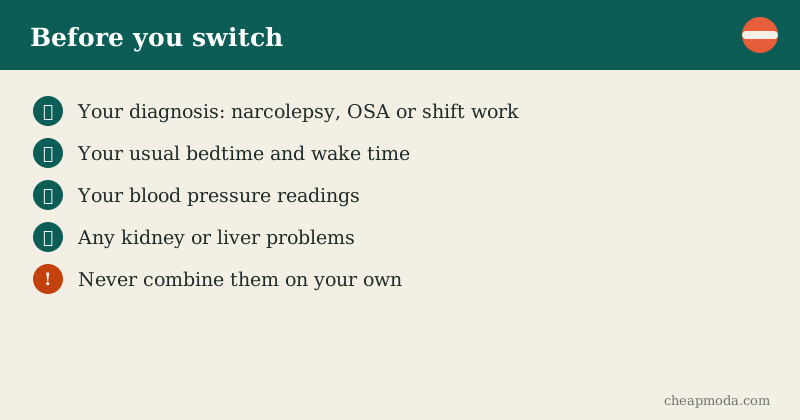
- Ignore "stack" advice. Combining wake-promoting drugs without a specialist is risky, especially with Sunosi's blood pressure warning.
- Treat dramatic stories as anecdotes. Labels are built on controlled trials with hundreds of patients.
Who might lean which way
This isn't advice, just the label logic a prescriber might weigh:
- Shift work disorder: Nuvigil, because Sunosi isn't approved for it.
- Trouble sleeping at night on a long-acting drug: Sunosi's shorter half-life may be worth discussing.
- High blood pressure or heart disease: extra caution with both, especially Sunosi given its label warning.
- Past serious rash on modafinil or armodafinil: Nuvigil is contraindicated, since its label lists hypersensitivity to either.
- Kidney disease: Sunosi needs dose limits or isn't recommended at the end stage.
- Cost: generic armodafinil usually wins.
Verdict
Sunosi vs Nuvigil isn't a contest with one winner. They're unrelated molecules with different half-lives, different approved uses and different safety warnings. Sunosi is shorter-acting and approved for narcolepsy and sleep apnea only, with a strong blood pressure warning. Nuvigil lasts longer, also covers shift work disorder, and is available cheaply as a generic. Use what people say on forums to shape your questions, then let your prescriber match the drug to your diagnosis, schedule and health.
FAQ
Is Sunosi better than Nuvigil?
Neither is better for everyone. Sunosi has a shorter half-life (about 7 hours vs about 15 hours), which can mean less effect at bedtime. Nuvigil is also approved for shift work disorder, which Sunosi isn't. Your doctor weighs these against your condition and health.
How does Sunosi work compared with Nuvigil?
The Sunosi label calls solriamfetol a dopamine and norepinephrine reuptake inhibitor. The Nuvigil label says armodafinil's exact mechanism is unknown, though it binds the dopamine transporter. Both labels say their mechanism isn't fully understood.
Can Sunosi be used for shift work?
Not according to its US label. Sunosi is approved only for excessive daytime sleepiness with narcolepsy or obstructive sleep apnea. Nuvigil's label also covers shift work disorder.
Which one raises blood pressure more?
Both labels mention increases. Sunosi's label has a prominent warning about dose-dependent rises in blood pressure and heart rate and asks for blood pressure to be controlled before starting. Nuvigil's label reports small average increases in trials. Anyone with heart or blood pressure problems needs a doctor's assessment.
Are Sunosi and Nuvigil controlled substances?
Yes. Both are Schedule IV in the US and need a prescription.
Is there a generic Sunosi?
We couldn't confirm a generic Sunosi on sale. Armodafinil, the drug in Nuvigil, has been available as a US generic for years, which usually makes it far cheaper.
Can I take Sunosi and Nuvigil together?
Don't combine them unless a specialist tells you to. The Sunosi label advises caution with other drugs that raise blood pressure or heart rate and with dopaminergic drugs.
Does Afinil sell Sunosi?
No. Afinil sells Indian generic armodafinil, including a generic Nuvigil 150 mg. It doesn't sell solriamfetol.