Modafinil for Sleep Disorders: What It's Approved to Treat
 Written by Dr. Marcus Bennett · · Fact-checked October 2026 · How we review
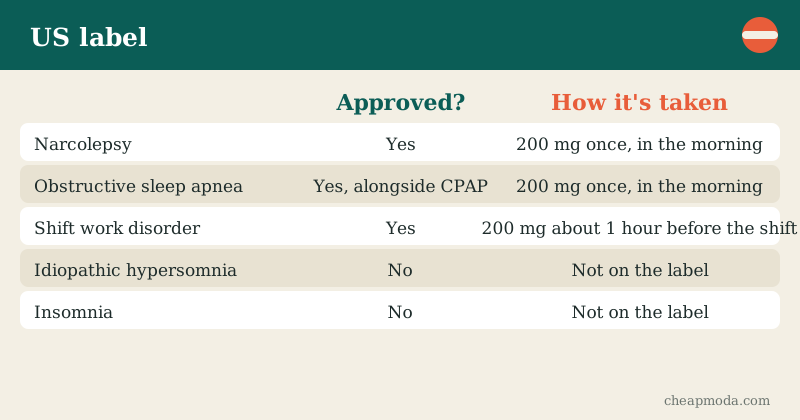
"Modafinil for sleep disorders" covers a narrower list than many people expect. Modafinil doesn't treat sleep disorders in the way CPAP treats apnea or a sleeping pill treats insomnia. Its job is to reduce excessive daytime sleepiness caused by specific conditions. This guide sets out the approved uses on the US Provigil label, how each one is dosed, and what modafinil isn't for, using the FDA label and Medication Guide. It isn't medical advice.
We earn a commission on purchases through our links, at no extra cost to you.
The short answer
- Approved in the US: excessive sleepiness from narcolepsy, obstructive sleep apnea (OSA) and shift work disorder (SWD), in adults.
- Usual dose: 200 mg once a day, in the morning for narcolepsy and OSA, or about 1 hour before the shift for SWD.
- Not on the US label: insomnia, idiopathic hypersomnia, or sleepiness caused simply by not sleeping enough.
- Legal status: a Schedule IV controlled substance, available with a prescription.
Narcolepsy
Narcolepsy is a long-term brain condition that causes overwhelming daytime sleepiness and, in some people, sudden muscle weakness (cataplexy). It was modafinil's first approved use: Provigil was approved in the US in 1998 for narcolepsy, and it remains a core indication today.
The US label dose for narcolepsy is 200 mg once a day in the morning. Modafinil helps with the sleepiness. It isn't described as a treatment for cataplexy, which is usually managed with other medicines.
Obstructive sleep apnea
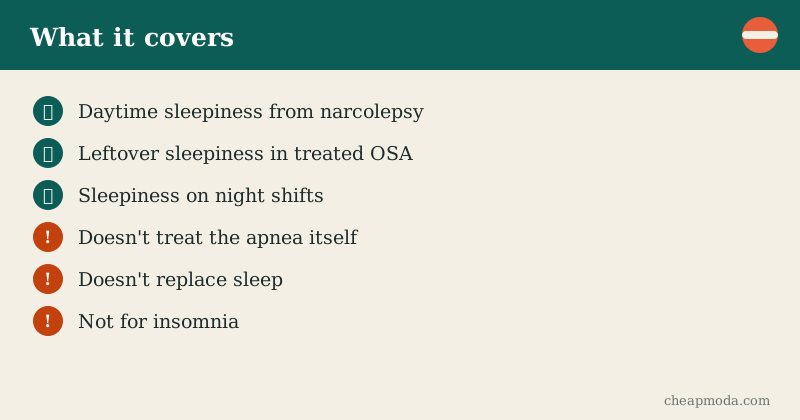
In OSA, the airway collapses repeatedly during sleep, breaking up rest and causing daytime sleepiness. The first treatment is aimed at the airway, most often CPAP. Some people still feel sleepy even after their apnea is well treated, and that leftover sleepiness is what modafinil is approved for in the US.
The US label is direct about this: modafinil isn't a treatment for the airway obstruction, and the underlying condition should be treated before and during modafinil use. The Medication Guide makes the same point in plain words: modafinil does not take the place of the treatments your doctor has prescribed for OSA, such as CPAP, and you should keep using them.
If you snore heavily, wake gasping or feel exhausted despite a full night in bed, the right first step is a sleep assessment, not a wakefulness pill.
Shift work disorder
Shift work disorder is excessive sleepiness during night or rotating shifts, often with poor sleep in the daytime. It's an approved US use. The label dose is 200 mg taken about 1 hour before the start of the work shift.
Modafinil doesn't fix the mismatch between your body clock and your schedule. It can reduce sleepiness during the shift, but because its effective half-life is about 15 hours, part of the dose is still active when you try to sleep afterward. Good daytime sleep habits, such as a dark, quiet room and a fixed sleep window, still matter.
It also helps to be clear about what SWD means. Feeling tired after one night shift is normal. Shift work disorder is a pattern of persistent sleepiness at work, or poor sleep at home, that goes on for weeks and affects safety or daily life. A doctor makes that call, often with a sleep diary. If you drive home after nights, drowsy driving is a real risk whatever you take, so plan for it.
How the US label sets the dose
The three approved uses share one dosing pattern on the US label: a single 200 mg dose a day, timed to the condition. A few more details from the label and Medication Guide apply to all three:
- One dose, at one time. The Medication Guide says to take it exactly as prescribed, and that your doctor will tell you the right time of day.
- Don't move the time on your own. It says not to change the time of day you take it unless you've talked to your doctor, because taking it too close to bedtime can make it harder to go to sleep.
- Higher doses. In narcolepsy and OSA, doses up to 400 mg a day were well tolerated, but there was no consistent evidence of extra benefit over 200 mg.
- Food. It can be taken with or without food. Food can delay the peak by about an hour.
- Dose adjustments. In severe liver impairment the label calls for half the usual dose, and in older adults a lower dose should be considered.
Our twice-a-day dosage guide explains why the label's single dose matters for sleep.
What modafinil is not for
- Insomnia: modafinil promotes wakefulness and can make sleep harder. It's the wrong tool for trouble sleeping.
- Sleep deprivation: the US Medication Guide says modafinil is not a replacement for sleep. If you're tired because you aren't sleeping enough, more sleep is the fix.
- Children: it isn't approved for anyone under 18 in the US.
- Idiopathic hypersomnia: not an approved US use. A specialist may still consider it off-label, which is a medical decision.
How doctors usually reach a diagnosis
Sleep disorders that cause daytime sleepiness often look alike from the outside. A typical route, which varies by clinic, looks something like this:
- History: your sleep pattern, work hours, snoring, naps, and any episodes of sudden weakness.
- Sleepiness questionnaires: such as the Epworth Sleepiness Scale.
- Sleep testing: an overnight study for apnea, and for suspected narcolepsy a daytime nap test (MSLT).
- Treatment plan: airway treatment for OSA, schedule changes for shift work, and medicine where it fits.
Getting the diagnosis right matters, because the right treatment for OSA (CPAP) is very different from the right treatment for narcolepsy. It also decides which part of the label applies to you, and so when your prescriber tells you to take each dose.
Questions worth asking your doctor
If you think one of these conditions fits you, these questions help make the first appointment useful:
- Which tests do I need to confirm the diagnosis?
- Is there a treatment to try before medicine, such as CPAP or a schedule change?
- If modafinil fits, what time of day should I take it?
- How will we judge whether it's working?
Please read our medical disclaimer as well.
Getting modafinil legally
In the US, modafinil is a Schedule IV controlled substance, and FDA-approved generics are sold by licensed pharmacies with a prescription. If you think you have one of these conditions, a sleep clinic or your primary care doctor is the place to start. Our online doctor guide covers legal telehealth options.
Afinil sells Indian export generics such as ModaXL 200 mg. These tablets aren't FDA-approved, and buying them without a prescription isn't a legal route in the US. Please read our legal notes first, and see our ModaXL 200 mg review for product details.
Verdict
Modafinil treats excessive sleepiness linked to specific sleep disorders, not the disorders themselves. The US label covers narcolepsy, obstructive sleep apnea (alongside airway treatment like CPAP) and shift work disorder, each with a single 200 mg daily dose timed to the condition. It isn't for insomnia, it isn't a replacement for sleep, and it isn't approved for children. If daytime sleepiness is affecting your life, start with a proper sleep assessment and let your doctor decide whether modafinil fits.
FAQ
What sleep disorders is modafinil used for?
In the US, modafinil is approved for excessive sleepiness caused by narcolepsy, obstructive sleep apnea and shift work disorder, in adults.
Does modafinil treat sleep apnea?
No. It treats the sleepiness that can remain after sleep apnea is treated. The US label says the airway problem itself still needs treatment, such as CPAP.
Is modafinil used for insomnia?
No. Modafinil is a wakefulness drug and can make sleep harder if it's taken too late in the day. It isn't a treatment for insomnia.
Is modafinil approved for idiopathic hypersomnia?
Not in the US. Idiopathic hypersomnia isn't on the FDA label, so any use for it is a prescriber's off-label decision.
How is modafinil taken for shift work disorder?
The US label gives 200 mg about 1 hour before the start of the work shift.
How is modafinil taken for narcolepsy or sleep apnea?
The US label gives 200 mg once a day, in the morning. The Medication Guide says your doctor tells you the right time of day, and not to change it without talking to them.
Is modafinil a sleeping pill?
No, it's the opposite. It promotes wakefulness during the day or shift. It doesn't help you fall asleep.
Do I need a sleep study before modafinil?
Diagnosis of narcolepsy or sleep apnea usually involves sleep testing. Your doctor decides what tests you need.