Modafinil Prior Authorization Criteria, Explained Plainly
 Written by Dr. Marcus Bennett · · Fact-checked November 2026 · How we review
If your pharmacy told you modafinil "needs a PA", that's normal. Modafinil (brand Provigil) and armodafinil (brand Nuvigil) are some of the most common drugs to need prior authorization in the US. The plan wants to see that you have one of the conditions the drugs are approved for before it pays.
This guide walks through the criteria insurers actually publish, using real plan policies we read on October 30, 2026: Cigna's coverage policy for wakefulness-promoting agents, a Blue Cross Blue Shield of Alabama program summary, and a 2024 Rhode Island Medicaid plan guideline from Point32Health. Your plan's own rules are what count, so treat this as a map, not a promise. It's general information, not medical or legal advice. We earn a commission if you buy through our Afinil links, at no extra cost to you.
The quick answer
- What's a prior authorization? A form your prescriber sends so the plan agrees to cover the drug before the pharmacy fills it.
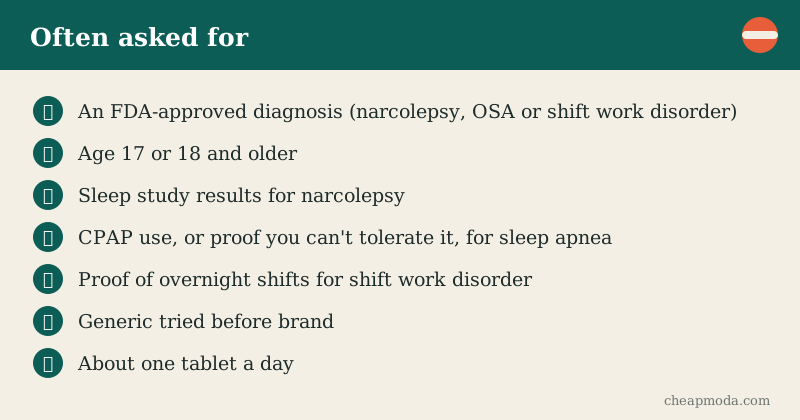
- Which diagnoses pass? Almost always the three FDA-approved ones: narcolepsy, obstructive sleep apnea (OSA) and shift work disorder.
- What proof is asked for? Usually a sleep study for narcolepsy, CPAP use (or proof you can't tolerate it) for OSA, and proof of overnight shifts for shift work disorder.
- Other common rules: age 17 or 18 and older, generics before brands, and about one tablet a day.
[IMG1]
Why modafinil needs a prior authorization at all
Modafinil and armodafinil are approved by the FDA to improve wakefulness in adults with excessive sleepiness from narcolepsy, OSA or shift work disorder. They're also widely used off-label, and there's a lot of interest in them for focus and studying. Insurers use prior authorization to make sure they're paying for the approved uses.
Both drugs are also Schedule IV controlled substances under federal law. That doesn't by itself create a prior authorization, but it does mean you need a valid prescription, refills are limited, and plans tend to watch quantities closely.
The criteria, one diagnosis at a time
Narcolepsy
Cigna's published policy approves modafinil or armodafinil for narcolepsy for one year when all of these are met:
- The patient is 18 or older.
- The patient has been evaluated with polysomnography (an overnight sleep study) and a multiple sleep latency test, with documentation.
- The narcolepsy diagnosis is confirmed, with documentation.
- The drug is prescribed by, or in consultation with, a sleep specialist or a neurologist.
- The plan's preferred product rules are met.
That's a fairly typical shape. If your diagnosis came from a sleep center, the records already exist. Your prescriber just has to attach them.
Obstructive sleep apnea
For OSA, the same Cigna policy asks for age 18 or older, plus one of two things: the drug will be used together with positive airway pressure therapy (CPAP, APAP or BPAP), or the patient can't start or tolerate positive airway pressure, with documentation. A South Carolina Medicaid criteria document we found during research takes a similar line, expecting patients to keep using CPAP or BiPAP after starting the drug.
The logic is simple. Modafinil doesn't fix the airway. It treats sleepiness that's left over once the apnea itself is being treated. If you've stopped using your CPAP, expect questions.
Shift work disorder
For shift work disorder, Cigna asks for age 18 or older and documentation that the patient works at least five overnight shifts a month. Working nights alone isn't the same as having the disorder, and at least one plan says so directly: the Point32Health guideline lists "shift work (i.e., works night shift)" as a non-medical condition it won't approve, while it does list shift work disorder as an approvable diagnosis.
Conditions beyond the big three
Some plans go further than the FDA-approved list. The Point32Health guideline for its Rhode Island Medicaid plan, effective October 8, 2024, lists excessive daytime sleepiness linked to several chronic conditions as approvable, including multiple sclerosis, chronic fatigue syndrome, Parkinson's disease, idiopathic hypersomnia, depression and cancer-related fatigue during chemotherapy, alongside narcolepsy, OSA and shift work disorder.
The same guideline lists uses it won't approve: generalized fatigue, travel or jet lag, and sleep deprivation such as military or academic use. That's a useful reminder that "I need to stay awake to study" isn't a covered use, even on a more generous plan.
If your condition isn't on your plan's list, your prescriber can still ask for a medical exception, but approval is much less certain.
Step therapy and preferred products
Many plans add a step therapy rule. Cigna's policy, for example, points patients to a Step 1 product (generic modafinil or generic armodafinil) before brand Nuvigil or brand Provigil. The Point32Health guideline says requests for brand-name products that have AB-rated generics go through its non-covered medication review.
In practice, that means you'll almost always be approved for a generic first. If you need the brand, your prescriber will have to explain why, for example a documented reaction to a generic's inactive ingredients.
Quantity limits
Quantity limits are where a lot of PAs get stuck. The Point32Health guideline sets these limits:
- Armodafinil 50 mg: two tablets a day.
- Armodafinil 150 mg and 250 mg: one tablet a day.
- Modafinil 100 mg and 200 mg: one tablet a day.
The Blue Cross Blue Shield of Alabama program summary approves doses above its limit if the dose is still within the maximum in the FDA labeling and can't be reached with fewer tablets of a higher strength. Doses above the labeled maximum need documentation and a clinical review. The same summary also requires that the patient is 17 or older, has no labeled contraindications, and has received only one of the two drugs (modafinil or armodafinil) in the past 90 days.
So if your prescriber wants you on two 100 mg tablets, expect the plan to push for one 200 mg tablet instead.
How the process usually goes
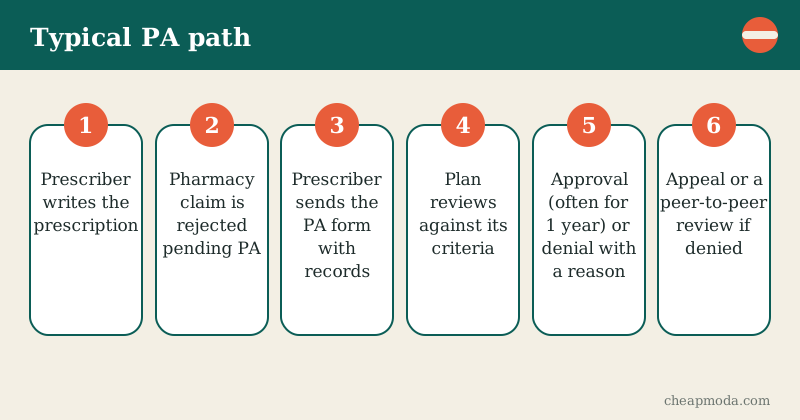
- Your prescriber sends the prescription to your pharmacy.
- The pharmacy runs it through your insurance, and the claim is rejected with a "prior authorization required" message.
- Your prescriber's office fills out the plan's PA form, often electronically, and attaches records like the sleep study, CPAP data or a work schedule.
- The plan reviews the request against its criteria. Standard reviews can take several days; urgent requests are faster.
- You get an approval, often for a year in the policies we read, or a denial letter that says why.
You can speed things up by asking your prescriber's office whether the PA has been sent, and by checking that your sleep study results and CPAP records are in your chart.
What to do if you're denied
A denial isn't the end of the road. The most common reasons are missing documentation, a diagnosis outside the plan's list, a brand request without a generic trial, or a quantity above the limit.
- Read the reason. The denial letter should say exactly which criterion wasn't met.
- Fix what's missing. If it's paperwork, your prescriber can resubmit with the records.
- Ask for a peer-to-peer. Many plans let the prescriber talk directly with the plan's reviewing clinician.
- File an appeal. Your plan's documents explain the deadline and the steps. If the internal appeal fails, many plans also offer an external review.
- Price it without insurance. Generic modafinil can be affordable with a prescription discount card. Our guide to modafinil cost without insurance explains what drives the cash price.
If you're on Medicaid, the rules are set by your state. State Medicaid programs publish their own criteria, often close to the ones above, and our guide to armodafinil cost with insurance looks at what you may pay once a plan approves you.
Getting the diagnosis in the first place
If you don't have a diagnosis yet, the PA criteria tell you what you'll need. For narcolepsy or OSA, that usually means a referral for a sleep study. For shift work disorder, it means a clinician documenting both your schedule and the sleep problem it causes. Some people try telehealth first; our guide to getting a modafinil prescription from an online doctor explains what's realistic for a controlled drug.
Where online stores fit
Some people look at overseas online stores after a denial. Be clear about what that means. Your insurer won't pay for those orders. Generics such as ModaXL aren't FDA-approved products. And because modafinil is Schedule IV in the US, buying it without a valid prescription or importing it from abroad isn't a legal route, whatever a site says. Our explainer on whether buying modafinil is legal covers the details, and our ModaXL 200 mg review and Afinil vendor review cover the store itself if you're comparing options with a prescriber's input.
For most people with an approvable diagnosis, getting the PA through for a pharmacy generic is the cheaper and safer path.
A made-up example
Here's an example to show how the criteria play out. The details are invented.
Sam is 34, was diagnosed with OSA two years ago and uses CPAP most nights, but still nods off at work. Sam's doctor prescribes generic modafinil 200 mg, one tablet each morning. The pharmacy says it needs a PA. The doctor's office sends the PA with the sleep study report and a CPAP usage download. Sam is over 18, is using CPAP, and the request is for a generic at one tablet a day, so it meets the typical criteria and is approved for a year.
Now change one detail: the doctor asks for brand Provigil, two 100 mg tablets a day. Under a policy like the ones above, that request would likely bounce twice, once for brand without a generic trial and once for using two lower-strength tablets instead of one 200 mg tablet.
Safety basics
Modafinil and armodafinil can cause headache, nausea, nervousness, anxiety and trouble sleeping. The labels also warn about rare but serious skin reactions and psychiatric symptoms. They can make hormonal birth control less effective. Tell your prescriber about every medicine you take and don't change your dose on your own. Read our medical disclaimer for more.
Verdict
Modafinil prior authorization criteria are strict but predictable. If you have narcolepsy, OSA or shift work disorder, the records to prove it, and a request for a generic at one tablet a day, you meet what most published policies ask for. If you don't have a diagnosis yet, start with your doctor and a sleep evaluation rather than a workaround. And if you're denied, find out which box wasn't ticked, because that's usually fixable.
FAQ
What are the prior authorization criteria for modafinil?
They vary by plan, but published policies usually require an FDA-approved diagnosis (narcolepsy, obstructive sleep apnea or shift work disorder), a minimum age of 17 or 18, proof for the diagnosis such as a sleep study, and a quantity limit of about one tablet a day.
Does insurance cover modafinil for ADHD or general tiredness?
Usually not under standard criteria, because those aren't FDA-approved uses. Some plans list extra conditions, so check your own plan's policy. One Rhode Island Medicaid plan guideline we read explicitly excludes generalized fatigue, jet lag and sleep deprivation.
Do I need a sleep study for a modafinil prior authorization?
For narcolepsy, usually yes. Cigna's published policy, for example, asks for polysomnography and a multiple sleep latency test. For sleep apnea, plans want the OSA diagnosis, which normally comes from a sleep study too.
Do I have to use CPAP to get modafinil covered for sleep apnea?
Many plans require that modafinil is used alongside positive airway pressure therapy such as CPAP, or that you've tried it and can't tolerate it. Modafinil treats leftover sleepiness, not the airway problem itself.
How long does a modafinil prior authorization last?
Approvals in the policies we read were often for one year, after which your prescriber may need to renew it. Some plans now approve for longer.
What is step therapy for modafinil?
It means the plan wants you to try a cheaper option first, usually generic modafinil or generic armodafinil, before it will cover brand Provigil or Nuvigil.
Can I get more than one modafinil tablet a day covered?
Most plans set a quantity limit of one tablet a day for modafinil 100 mg and 200 mg and for armodafinil 150 mg and 250 mg. Going above that usually needs extra documentation from your prescriber.
What if my modafinil prior authorization is denied?
Read the denial letter for the reason, then ask your prescriber about sending missing records, a peer-to-peer review with the plan's reviewer, or a formal appeal. You can also ask the pharmacist for the cash price of the generic with a discount card.