How Much Does Armodafinil Cost With Insurance?
 Written by Dr. Marcus Bennett · · Fact-checked October 2026 · How we review
Insurance should make a prescription simpler, but the first time you fill armodafinil you might hit a surprise: a prior authorization request, a higher-than-expected copay, or a note that the drug isn't on the formulary. This guide explains what really sets armodafinil cost with insurance in the US, what to do when a plan pushes back, and when paying cash might come out ahead. It isn't medical, legal or insurance advice. Your plan documents and your prescriber have the final word.
We earn a commission on purchases through our links, at no extra cost to you.
The short version
- Your plan, not the drug, sets the price. Generic armodafinil cost pharmacies about $0.80 per 150 mg tablet and $0.88 per 250 mg tablet in the October 2026 CMS NADAC survey. On most plans, your copay or coinsurance is what decides your bill.
- Prior authorization is common for drugs like this. Many plans want proof of a covered diagnosis before they pay for a wakefulness drug.
- Brand Nuvigil can be a coverage problem. Pharmacies paid about $34.70 per 250 mg brand tablet, so plans often steer people to the generic.
- Cash can sometimes win. Before a deductible is met, a cash or discount card price may be lower than the plan's price.
What sets your out-of-pocket cost
Five plan features do most of the work. It's worth pulling up your plan's summary of benefits or calling member services and asking about each one for armodafinil.
The formulary. This is the plan's list of covered drugs. If generic armodafinil is on it, you're in good shape. If it isn't, you'll need an exception or you'll pay the full price yourself.
The tier. Formularies sort drugs into tiers, and each tier has its own cost share. Generics usually sit on lower tiers with smaller copays, while brands sit higher. Some plans put certain generics on a higher tier anyway, so don't assume.
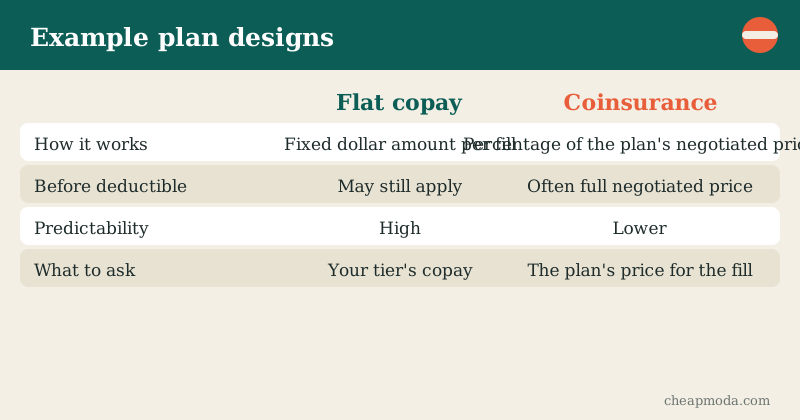
The deductible. On many plans, especially high-deductible ones, you pay the plan's negotiated price for prescriptions until the deductible is met. For a cheap generic that may still be a small amount, but it's not the same as the copay you'll see later in the year.
Copay or coinsurance. A copay is a fixed amount per fill. Coinsurance is a percentage of the plan's price. On an inexpensive generic either can be modest, but coinsurance on a brand drug can get expensive quickly.
Utilization rules. Prior authorization, step therapy (trying another drug first) and quantity limits can all apply. They don't change the price, but they decide whether the plan pays at all.
Why prior authorization comes up
Armodafinil is approved by the FDA to improve wakefulness in adults with excessive sleepiness from three conditions: narcolepsy, obstructive sleep apnea (OSA) and shift work disorder. It's also a Schedule IV controlled substance. Those two facts explain why insurers often want a closer look before they pay.
In practice, a prior authorization request usually asks your prescriber to confirm the diagnosis and sometimes to send supporting records, such as a sleep study for narcolepsy or OSA. For OSA, the label itself says armodafinil treats the sleepiness, not the blocked airway, and that a maximal effort with CPAP should be made first when CPAP is the treatment of choice. Plans sometimes ask about CPAP use for the same reason.
Some plans also use step therapy, asking that you try generic modafinil before armodafinil, or the other way round. That's a plan rule, not a medical judgment about you, and your prescriber can ask for an exception if there's a reason.
Medicare Part D and Medicaid
If you're on Medicare, outpatient prescriptions are covered through a Part D plan or a Medicare Advantage plan with drug coverage. Each one has its own formulary and tier structure. The most reliable way to check is the Medicare Plan Finder on medicare.gov: add armodafinil at your strength and quantity, and it estimates your cost under each plan in your area. If you're choosing a plan during open enrollment, it's worth doing this for every drug you take.
Medicaid coverage is set state by state. Most state programs publish a preferred drug list online, and that list will show whether armodafinil is preferred, needs prior authorization, or isn't covered.
What to do if your plan says no
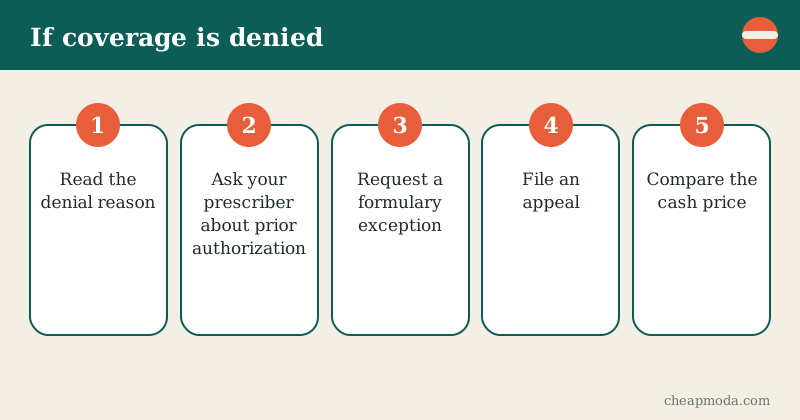
A denial isn't always the end of it. Here's the usual path:
- Read the denial reason. It might be a missing prior authorization, a step-therapy rule, a quantity limit, or the drug not being on the formulary. Each has a different fix.
- Ask your prescriber to submit prior authorization. Often the denial at the pharmacy simply means the paperwork hasn't been sent yet.
- Request a formulary exception. If armodafinil isn't covered, your prescriber can ask the plan to cover it anyway, explaining why it's needed.
- File an appeal. Plans must offer an appeals process. Your denial letter or plan documents explain the deadline and how to file.
- Compare the cash price. While you wait, a cash or discount card price for generic armodafinil may be affordable enough to bridge the gap.
Keep notes on who you spoke with and when. It makes follow-up calls much faster.
When cash beats your insurance
It sounds backwards, but it happens. Early in the plan year, before a deductible is met, you might be charged the plan's full negotiated price, and that can be higher than a pharmacy's cash price or a discount card price for a cheap generic. Some people also find that a plan's generic tier copay is higher than the cash price of a low-cost generic.
The catch is that cash purchases usually don't count toward your deductible or out-of-pocket maximum. If you take several medicines or expect big medical bills, keeping everything on insurance may still be the better plan. Ask the pharmacist to run the price both ways and decide with the full picture.
As a reference, the NADAC acquisition costs above suggest a fair cash price for 30 generic 150 mg tablets shouldn't be wildly higher than a few tens of dollars. That's an example based on what pharmacies pay, not a quote, and real cash prices vary by store.
Generic vs brand on insurance
| Generic armodafinil | Brand Nuvigil | |
|---|---|---|
| Pharmacy cost, October 2026 NADAC | About $0.80 (150 mg), $0.88 (250 mg) | About $34.70 (250 mg) |
| Typical formulary placement | Lower tier, where covered | Higher tier or not covered |
| Same active ingredient | Yes | Yes |
| Prescription needed | Yes | Yes |
If your prescriber writes for the brand and you'd be fine with the generic, ask whether substitution is allowed. If there's a medical reason for the brand, that reason is what a formulary exception request will need.
Where online imports fit
Some people without coverage look at online vendors. When we checked Afinil on October 22, 2026, its generic armodafinil 150 mg cost $29 for 10 tablets, $169 for 100, and about $0.89 a tablet in a 1,000 pack, with a 24% discount for Bitcoin payment. Insurance doesn't pay for these, the tablets aren't FDA-approved, and US law still requires a prescription for armodafinil. Our armodafinil 150 mg price guide covers the vendor pricing in detail, and our legal notes explain the risks.
Questions to ask your plan
Have your member ID card ready and ask:
- Is generic armodafinil on the formulary, and at what strengths?
- Which tier is it on, and what's the copay or coinsurance for that tier?
- Does it need prior authorization, step therapy or have a quantity limit?
- Have I met my deductible, and what would I pay today?
- Is a 90-day fill or the plan's mail-order pharmacy cheaper, and is that allowed for a controlled drug?
Safety and dosing notes
Coverage questions shouldn't drive dosing. The Nuvigil label recommends 150 mg or 250 mg once in the morning for OSA or narcolepsy, and 150 mg about an hour before the shift for shift work disorder, and it found no consistent extra benefit from 250 mg over 150 mg in the OSA and narcolepsy trials. The label also warns about serious rash, allergic reactions and psychiatric symptoms. See our armodafinil 150 mg dosage guide, how long armodafinil lasts, and our medical disclaimer, and talk to your doctor or pharmacist about your health history.
Verdict
With insurance, armodafinil cost comes down to your plan's formulary, tier, deductible and rules. Because the generic is inexpensive for pharmacies to buy, a plan that covers it as a generic often leaves you with a manageable copay. If you hit a prior authorization request or a denial, your prescriber can usually work through it, and in the meantime it's worth comparing the cash price. Stick with licensed US pharmacies and a valid prescription, since armodafinil is a Schedule IV drug.
FAQ
How much does armodafinil cost with insurance?
There's no single number, because each plan sets its own copay or coinsurance. Generic armodafinil cost US pharmacies about $0.80 per 150 mg tablet in October 2026 according to the CMS NADAC survey, so on a plan that covers it as a generic, the out-of-pocket cost is often modest. Your plan's formulary and deductible decide the exact amount.
Does insurance cover armodafinil?
Many plans cover generic armodafinil, but coverage isn't guaranteed. Some plans require prior authorization, a confirmed diagnosis such as narcolepsy, obstructive sleep apnea or shift work disorder, or a trial of another drug first. Check your plan's formulary or call the number on your card.
Why does my plan need prior authorization for armodafinil?
Prior authorization lets an insurer confirm a drug is being used for a covered reason before it pays. For armodafinil, that usually means your prescriber sends information about the diagnosis. The FDA-approved uses are excessive sleepiness from narcolepsy, obstructive sleep apnea and shift work disorder.
Does Medicare cover armodafinil?
Outpatient prescriptions under Medicare fall under Part D plans, and each plan has its own formulary. The Medicare Plan Finder on medicare.gov lets you enter your drugs and compare what each plan would charge, which is the most reliable way to check armodafinil.
Is it ever cheaper to skip insurance and pay cash?
Sometimes. If you haven't met a high deductible, the pharmacy's cash price or a discount card price for generic armodafinil can be lower than what the plan charges. Ask the pharmacist to compare both before you pay, but know that cash purchases may not count toward your deductible.
Will insurance pay for brand Nuvigil?
Plans often favor generics and may charge much more for the brand or not cover it without a reason from your prescriber. Brand Nuvigil 250 mg cost pharmacies about $34.70 a tablet in the October 2026 NADAC data, so the difference can be large.