Does Medicaid Cover Modafinil? What State Programs Actually Ask For
 Written by Dr. Marcus Bennett · · Fact-checked October 2026 · How we review
If you're on Medicaid and your doctor has suggested modafinil, the first question is simple: will the program pay for it? The honest answer is "probably, if your diagnosis fits and your prescriber fills in the forms." Medicaid is run by each state, so the rules for modafinil differ from one program to the next, but the published criteria follow a clear pattern.
This guide explains that pattern using real 2026 state documents, what a prior authorization request usually needs, what you'll typically pay at the pharmacy, and what to do if you're turned down. It's general information, not medical, legal or benefits advice. Your state Medicaid office, your health plan and your prescriber have the final say.
We earn a commission if you buy through our Afinil links, at no extra cost to you. Medicaid won't pay for anything bought that way, and we'll explain why below.
The short answer
- Coverage is common. Generic modafinil and armodafinil show up on state preferred drug lists (PDLs), usually marked with prior authorization (PA) and a quantity limit.
- PA is the norm. Modafinil is a Schedule IV controlled substance, and states want to confirm it's being used for an approved reason.
- Approved uses are narrow. Most criteria stick to the FDA label: excessive sleepiness from narcolepsy, obstructive sleep apnea (OSA) and shift work disorder (SWD).
- The copay is usually small. Federal rules cap Medicaid copays for preferred drugs at a nominal amount, and some states charge nothing.
Why Medicaid coverage varies by state
Medicaid is a joint federal and state program. Federal law sets the outer limits, and each state decides the details: which drugs are preferred, which need PA, how many tablets a month are allowed, and what the copay is. On top of that, many states hand pharmacy benefits to managed care plans, which follow the state list but may run their own PA forms.
That's why two people asking "does Medicaid cover modafinil" in different states can get different answers. The useful move is to look up your own state's PDL. Search for your state's name plus "Medicaid preferred drug list", then look in the section usually called "Stimulants and related agents", "Anti-narcolepsy agents" or "Analeptics". You'll see modafinil and armodafinil listed with codes such as PA (prior authorization required) and QL (quantity limit).
What real 2026 state criteria ask for
We read several published state documents to see what PA for modafinil actually involves. Here's what they say, in plain terms.
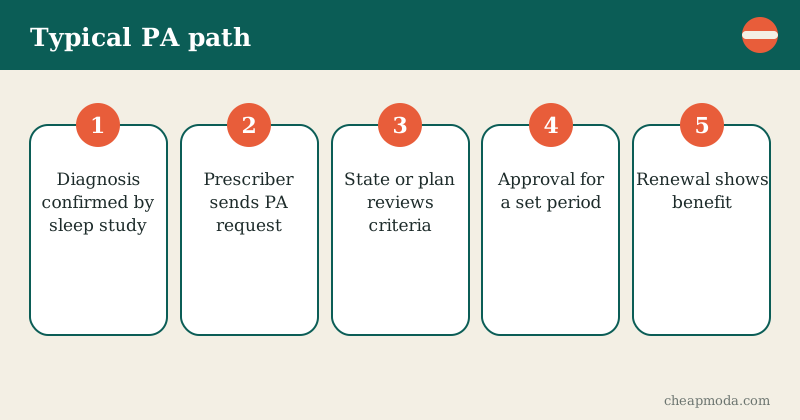
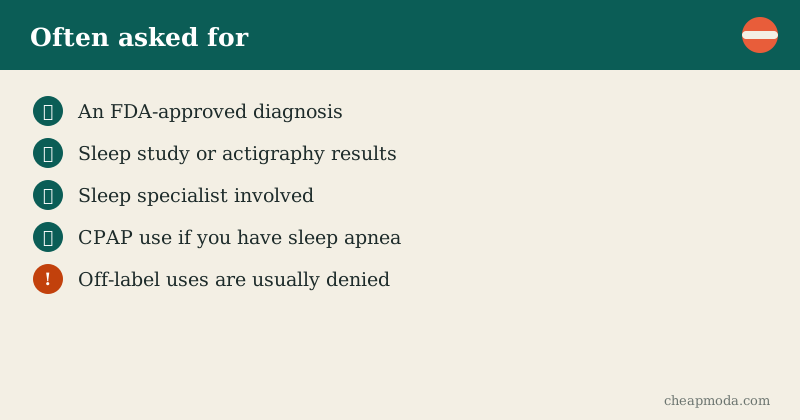
South Carolina (criteria revised January 2026). For adults, the request must come from a sleep specialist or be made in consultation with one. The diagnosis must be confirmed by a sleep study (polysomnography) or actigraphy, and it must be narcolepsy, shift work disorder or sleepiness linked to OSA. For shift work disorder, the state wants proof of the work schedule and symptoms lasting three months or more. For OSA, the person must be using CPAP or BiPAP and keep using it. The first approval lasts 6 months, and renewal lasts a year if records show the sleepiness has improved.
Pennsylvania (a Medicaid managed care policy reviewed November 2025). Every prescription for an analeptic such as modafinil or armodafinil needs PA. The reviewer checks for an FDA-approved or medically accepted use, that the person isn't also taking sedative sleeping pills, that narcolepsy or shift work disorder was diagnosed under current sleep-medicine guidelines, and, for OSA, that the diagnosis is confirmed and airway treatment is in place.
Georgia (PDL effective August 2026). Generic armodafinil is listed with PA and a quantity limit.
Indiana (criteria dated July 2026). The narcolepsy agents criteria cover narcolepsy, OSA with leftover daytime sleepiness despite treatment, and idiopathic hypersomnia, with an age minimum of 18.
The details differ, but the theme is the same everywhere: a documented sleep diagnosis, a specialist involved, and for sleep apnea, proof that the airway is being treated first. That matches the modafinil label itself, which says the drug treats sleepiness, not the blocked airway, and that CPAP should be used as well when it's the treatment of choice.
[IMG1]
What about off-label uses?
People are often prescribed modafinil for things outside the label, such as fatigue from multiple sclerosis, depression, ADHD or long COVID. Medicaid criteria are usually built around the label, so off-label requests are far more likely to be denied. A few states include extra sleep conditions, like Indiana's mention of idiopathic hypersomnia, but you shouldn't expect approval for focus, studying or general tiredness.
If your prescriber believes an off-label use is right for you, ask them whether your state allows a "medical necessity" exception and what records it needs. Some programs consider published evidence for a specific condition. Others simply don't.
How much you'll pay at the pharmacy
Medicaid copays are low by design. Under federal rules (42 CFR 447.53), states can charge different copays for preferred and non-preferred drugs, within caps:
| Your household income | Preferred drug | Non-preferred drug |
|---|---|---|
| At or below 150% of the federal poverty level | Up to $4 (base figure) | Up to $8 (base figure) |
| Above 150% of the federal poverty level | Up to $4 (base figure) | Up to 20% of what the state pays |
The dollar caps go up a little each year with medical inflation, so the real figures are slightly higher than the base numbers. Many states charge less than the cap, and some charge no pharmacy copay at all. Certain groups, including children and pregnant people, are usually exempt from most copays.
There's also a protection worth knowing: if your prescriber says the preferred drug would be less effective or cause side effects for you, the state must have a process to charge you only the preferred-drug copay for the non-preferred one.
For modafinil, this means the generic, if preferred, is usually the cheapest route by far. Brand Provigil is a different story. It's typically non-preferred and needs a stronger reason.
How to check your own coverage, step by step
- Find your plan. Look at your Medicaid card. If it names a managed care plan, that plan's formulary and PA form are what count.
- Look up modafinil on the PDL. Note whether it's preferred, needs PA and has a quantity limit (often one or two tablets a day).
- Read the PA criteria. Most states post them as PDFs. Check which diagnoses qualify and what records are needed.
- Talk to your prescriber. Ask whether your sleep study, CPAP data or work-schedule letter is already in your chart.
- Ask the pharmacy to run the claim. If it rejects, the message usually says why: PA needed, quantity limit, or not covered.
If your request is denied
A denial isn't always the end. First, read the reason. Many denials are about missing paperwork, such as no sleep study on file or no CPAP compliance data. Your prescriber can often fix that and resubmit.
If the request is denied on the merits, you have appeal rights. Medicaid managed care plans have an internal appeal process, and you can ask for a state fair hearing. Deadlines are short, so act quickly and keep copies of everything.
While you wait, it can help to ask your pharmacist for the cash price of generic modafinil with a discount card. Our guide to modafinil cost without insurance explains the typical numbers. Brand prices are much higher, as our Provigil vs generic comparison shows.
Where online imports fit (and where they don't)
Some people look at overseas online stores when Medicaid says no. Be clear about what that means. Medicaid will never pay for these orders, because it only pays enrolled US pharmacies for filled prescriptions. Generics such as ModaXL or Modalert aren't FDA-approved products. And in the US, modafinil is Schedule IV: buying it without a valid prescription, or importing it from abroad, isn't a legal route, even if a store labels it "OTC". Parcels can be seized. Our explainer on whether buying modafinil is legal covers the details.
If you already have a prescription and are comparing cash options, it's worth knowing what Afinil lists. On October 29, 2026, its ModaXL 200 mg page showed $3.99 a tablet for 10, $1.99 for 100 and $1.09 for 1,000, with a domestic USPS shipping option for US buyers. See our ModaXL 200 mg review and our look at whether Afinil is a legit vendor. For most Medicaid members, though, an approved generic at a few dollars a month is the better deal and the safer one.
Getting a prescription in the first place
If you don't have a diagnosis yet, the usual path is a primary care visit, then a referral for a sleep study. Medicaid generally covers sleep studies when they're medically needed, though it may need its own authorization. Some people ask about telehealth. Our guide to getting a modafinil prescription from an online doctor explains what's realistic for a controlled drug.
Safety notes
Modafinil can cause headache, nausea, anxiety and trouble sleeping. The label also lists rare but serious reactions, including severe rash and psychiatric symptoms. It can make hormonal birth control less effective. Tell your prescriber about every medicine you take, and don't change your dose on your own. Read our medical disclaimer for more.
Verdict
Does Medicaid cover modafinil? In most states, yes, for narcolepsy, obstructive sleep apnea and shift work disorder, as long as your prescriber gets prior authorization. Expect to need a sleep study, a sleep specialist in the loop and, for sleep apnea, proof of CPAP use. Once approved, the copay is usually a few dollars at most. If you're turned down, fix the paperwork, appeal, and check the generic's cash price before looking anywhere else.
FAQ
Does Medicaid cover modafinil?
In most states, yes, for its FDA-approved uses: excessive sleepiness from narcolepsy, obstructive sleep apnea and shift work disorder. Most programs require prior authorization first, and many add a quantity limit.
Does Medicaid cover armodafinil (Nuvigil)?
Usually on similar terms. Georgia's August 2026 preferred drug list, for example, shows generic armodafinil with prior authorization and a quantity limit. Brand Nuvigil and brand Provigil are more likely to be non-preferred.
What do I need for Medicaid prior authorization for modafinil?
It depends on the state, but published 2026 criteria commonly ask for a confirmed diagnosis (often by sleep study or actigraphy), a prescriber who is or consults a sleep specialist, and, for sleep apnea, proof you're using CPAP or BiPAP.
Will Medicaid cover modafinil for ADHD, depression or fatigue?
Usually not. Those are off-label uses, and most state criteria we read limit approval to the label conditions. A few states list extra conditions such as idiopathic hypersomnia, so check your own state's criteria.
How much is the Medicaid copay for modafinil?
Often nothing or a few dollars. Federal rules cap copays for preferred drugs at a nominal amount (the base figure is $4, adjusted for inflation each year). Non-preferred drugs can cost more, especially for people above 150% of the poverty level.
How long does a Medicaid approval for modafinil last?
It varies. South Carolina's 2026 criteria, for example, approve 6 months at first and 1 year on renewal, and renewal needs documentation that daytime sleepiness has improved.
Will Medicaid pay for modafinil bought online from an overseas store?
No. Medicaid pays enrolled US pharmacies for prescriptions they fill. Generics shipped from overseas stores aren't FDA-approved products, and in the US importing a Schedule IV drug without a valid prescription isn't a legal route.
What if my state denies coverage?
Read the denial reason, ask your prescriber to resubmit with the missing records or request an exception, and use your state's fair hearing or your plan's appeal process. You can also ask the pharmacist for the cash price of the generic.