The Night Shift Nurse's Guide to Fighting Fatigue
 Written by Dr. Marcus Bennett · · Fact-checked October 2026 · How we review
Night shift fatigue isn't a willpower problem. It's your body clock working against you at 4 a.m. Planned naps, smart caffeine timing, deliberate light and a protected daytime sleep block do most of the work, and wakefulness medicine is a doctor's call for a diagnosed sleep disorder.
Night shift nursing means making careful decisions when your body is built to be asleep. Medication math, patient checks and charting all land in the early-morning hours when alertness hits its lowest point. Federal workplace safety researchers at NIOSH (part of the CDC) have published training specifically for nurses on shift work and long hours, because fatigue is linked to errors, injuries and drowsy-driving crashes.
This guide pulls together the practical, widely recommended steps for managing night shift fatigue. It's general information for US nurses and other night clinicians, not personal medical advice, and not a substitute for your unit's fatigue policy.
Why 3 a.m. feels so hard
Your circadian rhythm, the body's internal clock, drives alertness in a daily wave. For most people, the lowest point falls between about 2 a.m. and 6 a.m. Body temperature drops, reaction time slows, and the urge to sleep peaks. Being awake for many hours adds a second pull toward sleep.
On a night shift, both forces hit together late in the shift, just when handoff and the drive home are coming up. Then daytime sleep is shorter because the clock is now pushing you awake. Over a run of shifts, that sleep debt builds.
Plan your sleep around the shift
Before your first night
Many nurses do well with a later bedtime and a longer lie-in the morning before the first night, then a nap in the afternoon. That way you start the shift with less time awake.
The pre-shift nap
A nap before a night shift is one of the best-supported fatigue tools. Fatigue programs commonly suggest 20 to 30 minutes in the late afternoon or early evening, or a full 90-minute cycle if you have time. Leave a buffer after waking so any grogginess passes before you drive.
After the shift
Try to go to bed soon after you get home rather than staying up for hours. A short wind-down helps, but long screen time delays sleep. Some nurses split sleep into a main block after the shift and a short nap before the next one.
Make the room work for you
- Blackout curtains or a quality eye mask
- Earplugs, a fan or white noise
- A cool room
- Phone on do-not-disturb, with family knowing your sleep hours
- A sign on the door if you share a home
Caffeine: when it helps and when it backfires
Caffeine is a useful tool when it's timed well. Its effects build within about 15 to 45 minutes and can last for many hours.
| Shift phase | Caffeine approach |
|---|---|
| Start of shift | Moderate dose if needed, such as a cup of coffee |
| Middle of shift | Small top-up only if you're struggling |
| Last part of shift | Skip it, so you can sleep after |
| Drive home | Don't rely on caffeine to make driving safe |
The FDA has noted that about 400 mg of caffeine a day, roughly four or five cups of coffee, isn't generally linked to negative effects in healthy adults. Energy drinks can add up fast. Large, late doses are one of the most common reasons daytime sleep falls apart.
Light and darkness: your strongest clock tools
Light is the main signal your body clock uses to set itself.
At work: bright light in the first half of the shift supports alertness. Where the unit allows it, keep the nurses' station well lit. Dim light is kinder for sleeping patients but harder on you, so get bright light during breaks or in workrooms.
After work: morning sunlight tells your brain the day has started, which makes it harder to sleep. Wraparound sunglasses, or blue-blocking glasses, on the way home help keep that signal low.
On days off: a fully flipped schedule is hard to keep. Many people do better keeping a partial overlap, such as going to bed late and sleeping in, rather than switching right back to a day pattern.
Food, movement and breaks
- Eat a normal meal before the shift, and keep night eating light, such as fruit, yogurt, nuts or soup. Heavy meals at 3 a.m. are tied to stomach upset and sluggishness.
- Stay hydrated, but cut back late in the shift so you're not up to use the bathroom while trying to sleep.
- Short walks, stretching or stairs on breaks give a quick boost.
- Use your breaks. A short break nap, where policy allows, can reduce sleepiness through the low point.
The drive home
Drowsy driving after night shifts is one of the most serious risks nurses face. Warning signs include yawning a lot, drifting out of your lane, missing exits or not remembering the last few miles.
- Nap before driving if you feel very sleepy.
- Carpool or use a ride service or public transit after hard runs.
- Pull over and rest if you notice warning signs.
- Don't count on loud music, open windows or extra coffee to keep you safe.
Where wakefulness medicines fit
Some nurses ask about modafinil or armodafinil. In the US, both are prescription-only Schedule IV medicines. The FDA has approved them to improve wakefulness in adults with excessive sleepiness from three conditions: narcolepsy, obstructive sleep apnea and shift work disorder.
That last one matters. Shift work disorder is a diagnosis, not just being tired after nights. It means persistent sleepiness or insomnia tied to your work schedule, usually for three months or more, with other causes ruled out. A doctor might consider a wakefulness medicine when good sleep habits and schedule changes aren't enough and sleepiness is still risky.
A few points worth knowing before that conversation:
- These medicines treat sleepiness, not missed sleep. The labels say they don't replace adequate sleep.
- They have side effects, including headache, nausea, anxiety and trouble sleeping, and rare serious reactions.
- They can reduce the effect of hormonal birth control.
- Many state boards and employers expect nurses to be fit for duty and to follow facility policies on medicines, so be open with occupational health if you're prescribed one.
Our shift work sleep disorder explainer covers symptoms, diagnosis and treatment in more detail, and our sleep disorders guide explains how each approved use is dosed.
When to see a doctor
Get checked if you have any of these:
- sleepiness that stays heavy even on days off
- loud snoring, gasping or pauses in breathing at night
- dozing while driving or during patient care
- low mood, anxiety or irritability that's building up
- relying on more caffeine or sleep aids to function
Untreated sleep apnea, depression and thyroid problems can all look like shift work fatigue, and each is treatable.
The bottom line
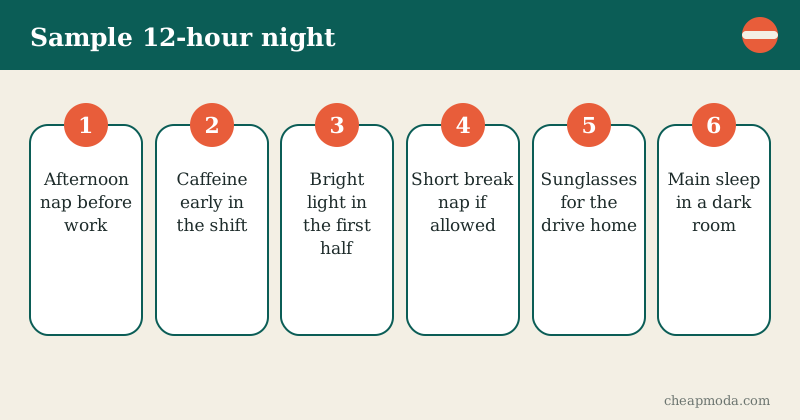
The most effective tools against night shift fatigue are free: a pre-shift nap, caffeine early, bright light at work and darkness after, and a protected sleep block. Use your breaks, plan the drive home, and treat dangerous sleepiness as a health issue worth a doctor's visit. Wakefulness medicines have a place, but only for a diagnosed condition and under a prescriber's care.
FAQ
How can night shift nurses stay awake?
Nap before the shift, use caffeine in the first half, keep the work area brightly lit early on, move around, and eat light meals. If sleepiness is still dangerous, see a doctor about shift work disorder or another sleep problem.
When should a night nurse drink coffee?
Earlier is better. Caffeine in the first half of the shift helps when you need it, and stopping in the second half gives it time to wear off before your daytime sleep.
How long should a nurse nap before a night shift?
Many fatigue programs suggest 20 to 30 minutes in the late afternoon or early evening. A longer 90-minute nap can also work if you have time to wake fully before driving.
Is it safe for nurses to take modafinil for night shifts?
Modafinil is prescription-only and FDA-approved for sleepiness from diagnosed shift work disorder. A doctor has to decide if it's right for you. It isn't meant to cover for missed sleep or understaffing.
How do I sleep during the day after a night shift?
Go to bed soon after getting home, keep the room dark, cool and quiet, put the phone on do-not-disturb, and wear sunglasses on the drive so morning light doesn't wake your brain up.