Shift Work Sleep Disorder Explained: Symptoms, Causes and What Actually Helps
 Written by Dr. Marcus Bennett · · Fact-checked October 2026 · How we review
Shift work sleep disorder is what happens when a work schedule keeps fighting your body clock for months: trouble sleeping when you're off, and heavy sleepiness when you're on. Most of the fix is schedule, light and sleep habits. Medicine is a backup a doctor adds once the diagnosis is clear.
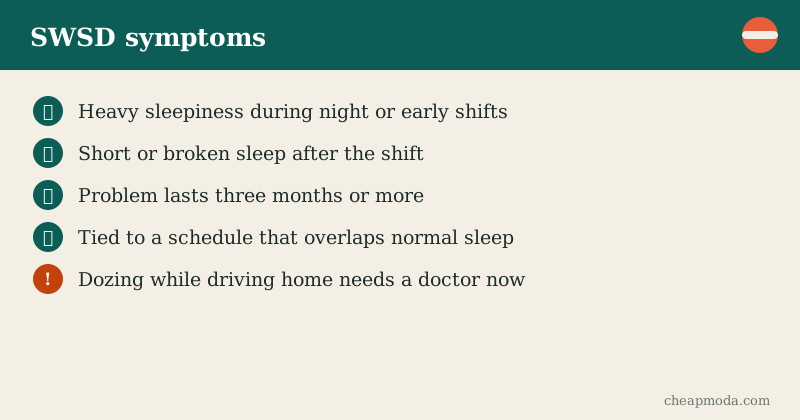
Shift work sleep disorder (often shortened to SWSD, or "shift work disorder") is one of the most common sleep problems in the US that people never get a name for. Nurses, truckers, factory crews, police officers, pilots, call-center staff and warehouse workers all work hours that ask the body to be alert when its internal clock is pushing for sleep. For many, that's just tiring. For some, it turns into a lasting disorder.
This guide explains what the condition is, how it shows up, how a doctor confirms it, the body-clock habits that help most, and where prescription wakefulness medicine fits. It's general information based on public sources such as the FDA drug labels and sleep medicine guidance, not personal medical advice.
What shift work sleep disorder actually is
Your body runs on a roughly 24-hour internal clock, the circadian rhythm. It's set mostly by light. Daylight tells the brain it's daytime, and darkness lets it release melatonin and wind down toward sleep. Body temperature, alertness and hormone levels all follow that rhythm.
Shift work asks you to flip or keep moving the schedule. Night shifts put work at the low point of the clock, usually between about 2 a.m. and 6 a.m., when alertness is lowest. Daytime sleep then happens while the clock is pushing you to be awake, so it's shorter and lighter. Very early starts and rotating shifts cause the same clash in milder or messier ways.
Shift work sleep disorder is the name for when that clash causes real symptoms that don't go away. Sleep medicine classifies it as a circadian rhythm sleep-wake disorder. The key features are:
- insomnia, excessive sleepiness, or both
- a clear link to a work schedule that overlaps the usual sleep period
- symptoms lasting at least about three months
- a total sleep time that's cut short
Not everyone on nights gets it. Estimates vary a lot by study, but a meaningful minority of night and rotating shift workers meet the criteria, while others adapt reasonably well. Age, being a natural "morning person," family duties during the day, and commute length all seem to matter.
Common symptoms
The symptoms fall into two groups: what happens at work, and what happens when you try to sleep.
At work, the main sign is sleepiness that's heavier than ordinary tiredness. People describe nodding off at a desk, losing focus, making more mistakes, or fighting to stay awake on breaks. Microsleeps, a few seconds of sleep without noticing, are a real safety concern for anyone driving or running equipment.
At home, sleep after a night shift is often short and broken. Many people wake after three or four hours and can't get back to sleep. Others lie awake before an early shift because the body isn't ready to sleep yet.
Other effects people commonly report include:
- irritability, low mood or a short temper
- headaches and trouble concentrating
- feeling "jet lagged" on days off
- relying on a lot of caffeine to get through shifts
- dozing while driving home, which is the warning sign to take most seriously
If you've nodded off at the wheel, even briefly, treat that as urgent. Pull over, don't drive drowsy, and talk to a doctor soon.
How doctors diagnose it
There's no blood test. A clinician, often a primary care doctor or a sleep specialist, diagnoses shift work sleep disorder from your history. They'll usually ask about your schedule, how long the problem has gone on, how you sleep on days off, and how sleepy you feel at work.
Many will ask you to keep a sleep diary for one to two weeks, and some use actigraphy, a small wrist device that tracks rest and activity. A questionnaire such as the Epworth Sleepiness Scale may be used to measure daytime sleepiness.
An important part of the visit is ruling out other causes. Obstructive sleep apnea, narcolepsy, depression, thyroid problems and other medicines can all cause sleepiness, and they're treated differently. If your doctor suspects sleep apnea or narcolepsy, they may order an overnight sleep study.
Body-clock habits that help first
Sleep medicine guidance puts schedule and environment changes first. They cost little, help most people, and make any later treatment work better.
Protect one main sleep period
Try to sleep at the same times after each shift, and keep a similar core block on days off where you can. Some people use an "anchor" sleep, a four-hour block they protect every day, with flexible sleep around it.
Make the bedroom truly dark and quiet
Blackout curtains or a good sleep mask, earplugs or a fan for noise, and a cool room all help daytime sleep. Put your phone on do-not-disturb and tell family and friends your sleep hours.
Use light on purpose
Bright light early in a night shift helps alertness and nudges the clock later. Near the end of the shift and on the way home, cut the light: dark or blue-blocking sunglasses on the morning drive can make it easier to fall asleep afterwards.
Nap before and during the shift
A 20 to 30 minute nap before a night shift reduces sleepiness. Where your workplace allows it, a short nap on a break can help too. Give yourself a few minutes after waking for grogginess to clear before driving or doing safety-critical work.
Time caffeine
Caffeine works best early in the shift. Stopping it in the second half gives it time to wear off before you need to sleep. Large doses late in a shift are a common reason daytime sleep falls apart.
Plan the commute
Drowsy driving after nights is a well-known risk. Carpooling, public transport, or a short nap before driving can all make the trip home safer.
Where prescription treatment fits
When habits aren't enough, doctors have a few options. Which one fits depends on whether the main problem is sleepiness at work or poor sleep at home.
| Problem | What doctors may consider | What it's for |
|---|---|---|
| Sleepiness during the shift | Modafinil or armodafinil (prescription) | FDA-approved to improve wakefulness in shift work disorder |
| Trouble sleeping after the shift | Melatonin timing, sometimes short-term sleep aids | Helping daytime sleep, under a clinician's guidance |
| Clock not adapting | Scheduled bright light and darkness | Shifting the circadian rhythm |
When doctors prescribe modafinil
Modafinil (brand Provigil) and armodafinil (brand Nuvigil) are approved by the FDA to improve wakefulness in adults with excessive sleepiness from three conditions: narcolepsy, obstructive sleep apnea and shift work disorder. For shift work disorder, the US labels say modafinil 200 mg or armodafinil 150 mg is taken about one hour before the start of the work shift.
Doctors usually think about it when sleepiness at work is persistent and risky despite good habits, the diagnosis is clear, and other causes have been ruled out. The labels are clear that these medicines treat sleepiness, not the cause, and don't replace adequate sleep.
They're not for everyone. Both are Schedule IV controlled substances in the US and need a prescription. The labels list side effects such as headache, nausea, nervousness and trouble sleeping, plus rare but serious skin reactions and psychiatric symptoms that need urgent care. They can also make hormonal birth control less effective. Your prescriber will check your other medicines and health history first. Our sleep disorders guide covers how each approved use is dosed.
Questions to bring to your doctor
A short list makes the appointment more useful:
- How long have I had these symptoms, and do they match shift work disorder?
- Could sleep apnea, narcolepsy or something else be causing the sleepiness?
- Should I keep a sleep diary or do a sleep study first?
- What light, nap and caffeine plan fits my schedule?
- Is a wakefulness medicine right for me, and what should I watch for?
- Is it safe for me to drive home after a night shift right now?
When shift work isn't the whole story
If sleepiness carries on when you're on days, on vacation, or getting plenty of sleep, it may not be shift work alone. Loud snoring, gasping at night, sudden muscle weakness when laughing, or falling asleep in the middle of activities are all reasons to ask about a sleep study.
The bottom line
Shift work sleep disorder is common, real and treatable. For most people, protecting sleep, using light on purpose, napping before shifts and timing caffeine do the heavy lifting. When that's not enough, a doctor can confirm the diagnosis and decide whether a prescription such as modafinil belongs in the plan. Either way, sleepiness behind the wheel is the symptom never to ignore.
FAQ
What is shift work sleep disorder?
It's a circadian rhythm sleep disorder. A work schedule that overlaps your normal sleep time causes insomnia, excessive sleepiness, or both, and the problem keeps going for months rather than days.
How do I know if I have shift work sleep disorder?
Only a clinician can diagnose it. They usually look for symptoms lasting at least three months that line up with your work schedule, often using a sleep diary or a wrist activity tracker for a couple of weeks, and they rule out other causes such as sleep apnea.
Is modafinil FDA-approved for shift work sleep disorder?
Yes. The FDA label for Provigil (modafinil) and Nuvigil (armodafinil) includes improving wakefulness in adults with excessive sleepiness from shift work disorder. It treats the sleepiness, not the underlying schedule problem.
How is modafinil taken for shift work disorder?
On the US label, modafinil is 200 mg taken about one hour before the start of the work shift, and armodafinil is 150 mg about one hour before. Your prescriber decides whether it's right for you and at what dose.
Can shift work sleep disorder go away?
Symptoms often ease when the schedule changes to daytime work. For people who stay on nights or rotating shifts, consistent sleep timing, light control and planned naps can make a big difference.
Is shift work sleep disorder dangerous?
The biggest risk is sleepiness at the wrong moment, especially on the drive home. Long-term shift work is also linked to other health problems, which is one more reason to talk to a doctor if you're struggling.