Narcolepsy Basics: Symptoms, Diagnosis and Treatment in Plain Terms
 Written by Dr. Marcus Bennett · · Fact-checked October 2026 · How we review
Narcolepsy is a long-term brain condition that makes it hard to stay awake during the day, no matter how much you sleep at night. It's diagnosed with a sleep study, and treatment usually combines planned naps with one or more medicines, such as modafinil, chosen by a sleep specialist.
Narcolepsy is often misunderstood. It isn't laziness or simply being a heavy sleeper, and it's not as rare as many people think. In the US, estimates suggest it affects roughly 1 in 2,000 people, and many go years before getting a diagnosis.
This guide explains the condition in plain terms: what it is, the main symptoms, how doctors diagnose it, and the first-line treatments US sleep specialists use. It's based on public sources such as the National Institute of Neurological Disorders and Stroke (NINDS), the FDA drug labels and the American Academy of Sleep Medicine (AASM). It's general information, not medical advice.
What narcolepsy is
Your brain normally keeps sleep and wakefulness in separate, stable states. In narcolepsy, the line between them blurs. Pieces of sleep, especially REM sleep (the dreaming stage), break into waking hours, and nighttime sleep can be broken too.
In many people with the condition, the brain has lost cells that make hypocretin (also called orexin), a chemical that helps keep you awake and stabilizes REM sleep. Researchers think an autoimmune process may be involved in many cases, though the full cause isn't known.
Two types
| Type 1 | Type 2 | |
|---|---|---|
| Daytime sleepiness | Yes | Yes |
| Cataplexy | Usually present | Absent |
| Hypocretin level | Low | Normal |
Main symptoms
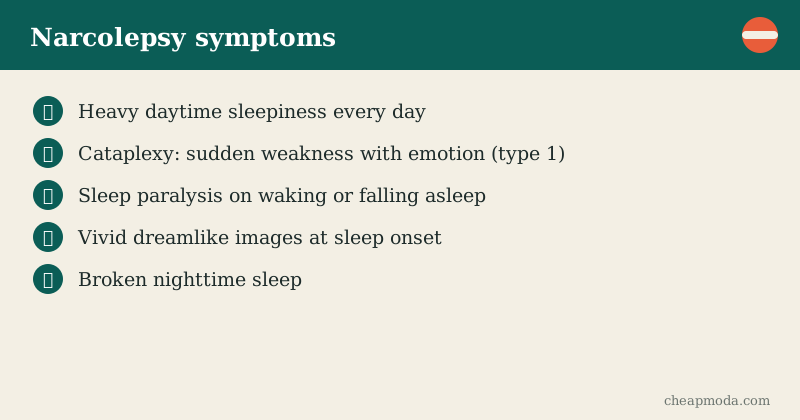
Not everyone has every symptom. The classic signs are:
Excessive daytime sleepiness
This is the core symptom and is present in everyone with narcolepsy. It's a constant background sleepiness, with times when the urge to sleep is overwhelming. People may fall asleep in meetings, in class, mid-conversation or while eating. Short naps can feel refreshing, but the sleepiness returns.
Cataplexy
Cataplexy is a sudden, brief loss of muscle tone triggered by strong emotion, often laughter, surprise or anger. It can be mild, like a sagging face or weak knees, or strong enough to make someone collapse. The person stays aware during it. Cataplexy is a key sign of type 1.
Sleep paralysis
A short period of being unable to move or speak when falling asleep or waking up. It can be frightening but passes within seconds to minutes.
Hallucinations at sleep onset or waking
Vivid, dreamlike images or sounds as you fall asleep (hypnagogic) or wake up (hypnopompic).
Broken nighttime sleep
Many people with narcolepsy wake up often during the night, even though they're sleepy during the day.
How doctors diagnose it
Diagnosis usually starts with a primary care doctor and moves to a sleep specialist.
- History. The doctor asks about sleepiness, cataplexy, sleep habits and medicines. Questionnaires like the Epworth Sleepiness Scale help measure sleepiness.
- Sleep diary or actigraphy. One to two weeks of tracking makes sure you're getting enough sleep before testing.
- Overnight sleep study (polysomnography, PSG). This checks for other causes such as sleep apnea.
- Multiple Sleep Latency Test (MSLT). The next day, you take four or five scheduled naps. Falling asleep in an average of eight minutes or less, and entering REM sleep early in at least two naps, supports a narcolepsy diagnosis.
- Sometimes a spinal fluid test. Low hypocretin confirms type 1, though this test isn't done routinely.
Doctors often ask you to stop certain medicines before testing, since some affect REM sleep. Don't stop anything without your prescriber's advice.
First-line treatments in plain terms
There's no cure yet, but treatment helps most people a lot. Treatment usually mixes daily habits with medicine.
Habits and scheduling
- Scheduled naps. Short planned naps, often 15 to 20 minutes, at set times can cut sleepiness.
- A regular sleep schedule. Going to bed and waking at the same time daily.
- Avoiding alcohol and heavy meals before times you need to be alert.
- Workplace or school accommodations. Breaks for naps, flexible scheduling. Narcolepsy may qualify for accommodations under the Americans with Disabilities Act.
Medicines
In 2021, the AASM published a clinical practice guideline on treating central disorders of hypersomnolence. In plain terms, for narcolepsy it:
| Medicine | What it does | Guideline strength for narcolepsy |
|---|---|---|
| Modafinil (Provigil) | Wakefulness-promoting agent | Strong |
| Pitolisant (Wakix) | Boosts histamine, an alertness signal | Strong |
| Sodium oxybate (Xyrem) | Taken at night; helps sleepiness and cataplexy | Strong |
| Solriamfetol (Sunosi) | Wakefulness-promoting agent | Strong |
| Armodafinil (Nuvigil) | Longer-acting form of modafinil | Conditional |
| Methylphenidate, amphetamines | Stimulants | Conditional |
Newer options also exist, such as low-sodium oxybate (Xywav), a version of sodium oxybate with much less sodium. Which one a doctor chooses depends on your symptoms, other health conditions, side effects, insurance and how you respond. Some people need more than one.
Where modafinil fits
Modafinil and armodafinil are FDA-approved to improve wakefulness in adults with narcolepsy. On the US label, modafinil is 200 mg taken once in the morning. They're widely used as a first option for daytime sleepiness because they're generally well tolerated and Schedule IV, a lighter category than traditional stimulants.
A few things to know:
- They help sleepiness but don't treat cataplexy, so people with type 1 may need another medicine too.
- Common side effects include headache, nausea and nervousness. Rare serious skin reactions need urgent care.
- They can reduce the effect of hormonal birth control.
- They're prescription-only in the US.
Our armodafinil vs modafinil for narcolepsy comparison goes deeper on how the two differ, and the sleep disorders guide covers each FDA-approved use.
Living with narcolepsy
Driving
Sleepiness and cataplexy can make driving dangerous. Many people with well-controlled symptoms drive safely, but rules vary by state and for commercial licenses. Ask your doctor whether driving is safe for you right now.
Work and school
Short scheduled naps, a predictable schedule and accommodations make a big difference. Telling a trusted manager or school disability office can help.
Mental health
Living with an invisible condition can be draining. Depression and anxiety are more common in people with narcolepsy, and they're treatable too.
When to see a doctor
See a doctor if you're sleepy most days despite enough sleep, fall asleep at unexpected times, or have sudden weakness when laughing or surprised. Early diagnosis means earlier treatment and safer daily life.
The bottom line
Narcolepsy is a lifelong but manageable brain condition. A sleep study confirms it, and treatment combines planned naps and a steady routine with first-line medicines such as modafinil, pitolisant, sodium oxybate or solriamfetol. A sleep specialist helps choose the right mix for your symptoms.
FAQ
What is narcolepsy?
It's a chronic neurological disorder in which the brain can't properly control sleep and wake states. The main symptom is strong daytime sleepiness, often with sudden sleep attacks, even after a normal night's sleep.
What is the difference between type 1 and type 2 narcolepsy?
Type 1 includes cataplexy or low levels of the brain chemical hypocretin (orexin). Type 2 has the same daytime sleepiness but no cataplexy and normal hypocretin levels.
How is narcolepsy diagnosed?
Usually with an overnight sleep study followed by a daytime nap test called the Multiple Sleep Latency Test (MSLT). Falling asleep very quickly and entering REM sleep early on several naps supports the diagnosis.
What is the first-line treatment for narcolepsy?
It depends on symptoms. The American Academy of Sleep Medicine's 2021 guideline strongly recommends modafinil, pitolisant, sodium oxybate and solriamfetol for daytime sleepiness, alongside scheduled naps and good sleep habits.
Is modafinil used for narcolepsy?
Yes. Modafinil (Provigil) and armodafinil (Nuvigil) are FDA-approved to improve wakefulness in adults with narcolepsy. On the label, modafinil is 200 mg taken once in the morning. They help sleepiness but don't treat cataplexy.
Can narcolepsy be cured?
Not yet. It's a lifelong condition, but treatment helps most people manage symptoms, work, study and drive more safely.