Armodafinil vs Modafinil for Narcolepsy
 Written by Dr. Marcus Bennett · · Fact-checked October 2026 · How we review
Narcolepsy is a long-term neurological sleep disorder, and daytime sleepiness is usually the symptom that hits work, study and driving hardest. Modafinil and armodafinil are two of the medicines doctors use for that sleepiness. If yours has suggested one, or you're on one and wondering about the other, this page lays out what the official US labels say about each for narcolepsy specifically.
We aren't doctors. Narcolepsy needs a proper diagnosis and ongoing care, and nothing here replaces that. We earn a commission on purchases through our links at no extra cost to you.
What each drug is
Modafinil (brand Provigil) is a mixture of two mirror-image forms of one molecule. Armodafinil (brand Nuvigil) is just one of those forms, the R form, which is the longer-lasting half. Both came from the same original company, Cephalon, now part of Teva.
In practice, this means armodafinil gives a similar effect at a lower milligram dose. A 150 mg armodafinil tablet is the usual counterpart of a 200 mg modafinil tablet, not a weaker version.
What they're approved to do in narcolepsy
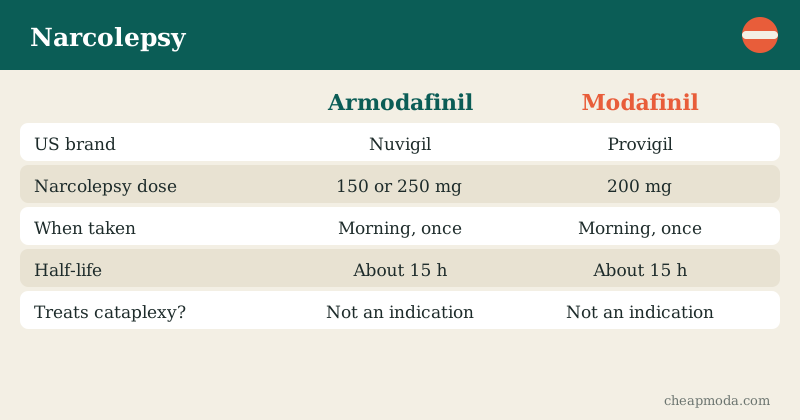
Both US labels have the same narcolepsy indication: to improve wakefulness in adults with excessive sleepiness associated with narcolepsy.
That wording matters. They're approved for the sleepiness, not for narcolepsy as a whole. The labels say both drugs treat the symptom, not the underlying cause. Cataplexy, sleep paralysis and hypnagogic hallucinations, which some people with narcolepsy also have, aren't approved indications for either drug.
Narcolepsy doses on the labels
| Armodafinil (Nuvigil) | Modafinil (Provigil) | |
|---|---|---|
| Label dose | 150 mg or 250 mg | 200 mg |
| Frequency | Once a day | Once a day |
| Timing | Morning | Morning |
| Tablet sizes | 50, 150, 200, 250 mg | 100, 200 mg |
| Higher doses | Not covered beyond 250 mg | Up to 400 mg tolerated, no consistent extra benefit |
Both labels mention dose reductions for people with severe liver impairment, and suggest considering lower doses in older adults. Your prescriber sets the dose. Don't adjust it on your own.
How long each one lasts through the day
For someone with narcolepsy, the afternoon slump is often the hardest part. So duration matters more here than for many other uses.
Both labels give an elimination half-life of about 15 hours. With modafinil, that figure applies after repeated dosing; the short-acting S form inside it clears faster, so the overall level falls off differently from pure armodafinil.
Armodafinil peaks about 2 hours after a dose on an empty stomach, and food can delay that by 2 to 4 hours. Modafinil peaks within 2 to 4 hours.
The practical upshot that people report: armodafinil can feel like it holds into the late afternoon a little better. The flip side is that it may make it harder to fall asleep at night. Narcolepsy already disrupts night-time sleep for many people, so that trade-off is worth raising with your doctor.
How the trials measured them
Both labels describe placebo-controlled trials in adults with narcolepsy. They used similar measures:
- The Maintenance of Wakefulness Test (MWT). You sit in a dim room and try to stay awake; the test measures how long you manage it.
- The Clinical Global Impression of Change (CGI-C). A clinician rates whether your overall condition has improved.
Each drug did better than placebo on these measures in its own trials. We haven't found a head-to-head comparison on either US label, so neither label says one is better than the other for narcolepsy. Be wary of anyone who claims otherwise with confidence.
The warning that matters most for narcolepsy
Both labels include a warning about persistent sleepiness. People treated with these drugs may still not reach normal levels of wakefulness. Prescribers are told to reassess sleepiness regularly, and patients are told not to drive or do other dangerous activities until they know how the drug affects them.
That's particularly relevant to narcolepsy, where sudden sleep attacks are part of the condition. A good day on the medication doesn't mean every day will be.
Side effects
The side effect lists look almost the same:
- Headache, the most common on both labels
- Nausea and dizziness
- Insomnia
- Anxiety
Serious but rare warnings on both include severe skin rashes such as Stevens-Johnson syndrome, allergic reactions with swelling of the face or throat, psychiatric symptoms, and heart symptoms like chest pain. Both labels also warn that they can make hormonal birth control less effective during treatment and for a month after stopping. If any of these apply to you, talk to your doctor.
Other narcolepsy medicines exist
Modafinil and armodafinil aren't the only options. Doctors also use other wake-promoting medicines and stimulants for sleepiness, and some medicines are used for cataplexy. Examples you may hear about include solriamfetol (Sunosi), pitolisant (Wakix), oxybate medicines and traditional stimulants like methylphenidate.
Which is best depends on your symptoms, other health conditions and how you respond. A sleep specialist can walk you through them. We don't cover these medicines in depth here.
Cost compared
In the US, generic modafinil and generic armodafinil are both available, and insurance plans often cover one or both, sometimes with prior authorization. The cheaper option for you depends entirely on your plan, so ask your pharmacist to price both.
For reference, here's what Afinil listed on October 22, 2026, before shipping:
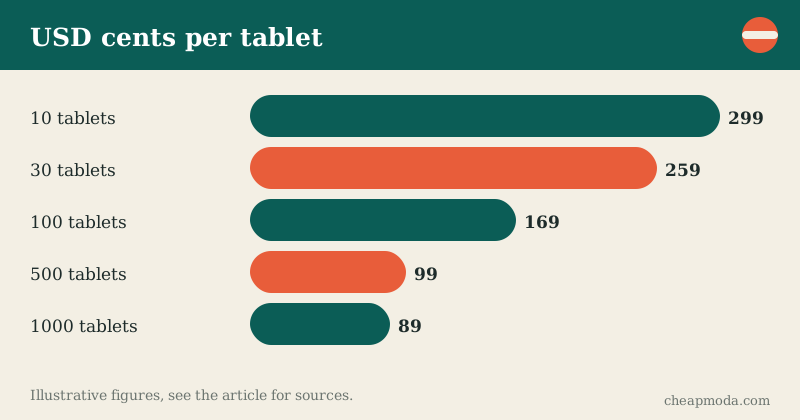
- Generic armodafinil 150 mg (HAB Pharma): $29 for 10, $79 for 30, $169 for 100, $499 for 500, $899 for 1,000.
- Generic Provigil 200 mg (HAB Pharma): the same totals.
- ModaXL 200 mg (HOF Pharmaceuticals): $39 for 10, $89 for 30, $199 for 100, $1,099 for 1,000.
As an example, one tablet a day for 30 days at the 30-tablet price would be $79 for either HAB product, plus shipping because the order is under Afinil's $130 free-shipping threshold. These export generics aren't FDA-approved, and we haven't tested them. Our Artvigil vs Waklert comparison goes deeper on the armodafinil brands.
Narcolepsy is a lifelong condition for most people, so a stable, legal, prescribed supply matters more than a low price. Missed deliveries or seized parcels can leave you without medicine at the worst moment.
The legal side
Both drugs are Schedule IV controlled substances in the US, and importing either without a prescription isn't a legal route; US customs can seize parcels. Our legal notes explain the US rules, and our online doctor guide covers how to get a prescription.
Medication is only part of the plan
Sleep specialists rarely treat narcolepsy with a pill alone. Common non-drug advice includes keeping a regular bedtime and wake time, planning short scheduled naps, and being careful with heavy meals before tasks that need focus. Many people also keep a simple sleepiness diary so their doctor can see whether a dose change actually helped.
That diary is useful when comparing armodafinil and modafinil too. If your doctor switches you from one to the other, note the time you took it, when you felt the effect fade, how you slept that night, and any side effects. A few weeks of notes are far more useful in an appointment than a vague sense of "it felt better."
Questions to ask your sleep specialist
- Is my main problem daytime sleepiness, cataplexy or both?
- Would a longer-lasting option help my afternoons, or hurt my night sleep?
- What's the plan if one drug doesn't control my sleepiness well enough?
- Is it safe for me to drive, and how will we check?
- Which one does my insurance cover best?
Verdict
For narcolepsy, armodafinil and modafinil are close relatives with the same approved use: the daytime sleepiness. The labels give armodafinil at 150 mg or 250 mg and modafinil at 200 mg, both once in the morning. Armodafinil may hold a little longer into the day. Neither label claims it's better than the other, and neither treats cataplexy. Pick with your sleep specialist, fill it legally, and read our medical disclaimer before acting on anything here.
FAQ
Is armodafinil or modafinil better for narcolepsy?
Both US labels approve them for excessive sleepiness in adults with narcolepsy, and there's no label claim that one works better. The choice usually comes down to timing, tolerance and cost.
What dose of armodafinil is used for narcolepsy?
The Nuvigil label lists 150 mg or 250 mg once a day in the morning.
What dose of modafinil is used for narcolepsy?
The Provigil label lists 200 mg once a day in the morning. Doses up to 400 mg a day were tolerated in trials, with no consistent evidence of extra benefit.
Do they help cataplexy?
Cataplexy isn't an approved indication on either US label. Their approved use is excessive daytime sleepiness. Other medicines are used for cataplexy.
Which lasts longer for narcolepsy?
Both labels give a half-life of around 15 hours. Pure armodafinil keeps more of the long-acting form, and some people notice its effect later in the day.
Will either make me fully alert?
Not necessarily. Both labels warn that wakefulness may not return to normal, so don't drive until you know how you respond.
Can I take them together?
No. Armodafinil is part of modafinil, so taking both doubles up on the same drug.
Do I need a prescription?
Yes. Both are Schedule IV controlled substances in the US, so you need a valid prescription from a US-licensed prescriber.