Modafinil vs Ritalin vs Adderall: Three Different Drugs, Side by Side
 Written by Dr. Marcus Bennett · · Fact-checked October 2026 · How we review
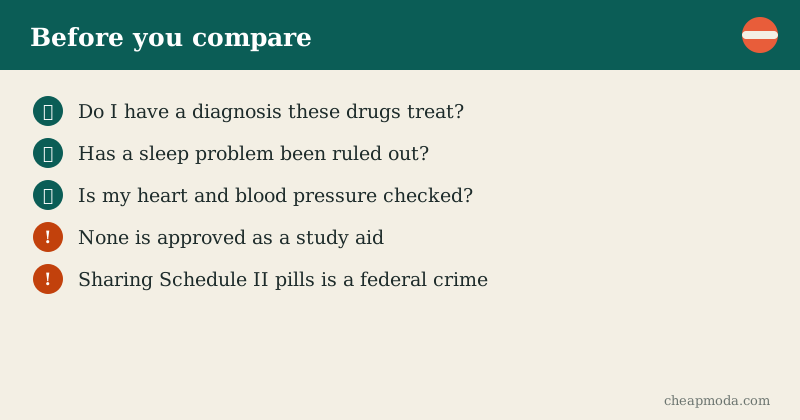
If you've typed modafinil vs Ritalin vs Adderall into a search bar, you've probably seen all three described as "focus pills." That label hides how different they are. Ritalin and Adderall come from two separate stimulant families. Modafinil isn't a classic stimulant at all. This guide compares them using the FDA-approved US labels and published research, so you can make sense of the differences before talking to a doctor.
First, the usual cautions. This is general information, not medical advice. We haven't run any trials or tested these drugs. All three are prescription-only in the US, and none is approved as a study or productivity aid. We earn a commission if you buy through our Afinil links, at no extra cost to you.
The short answer
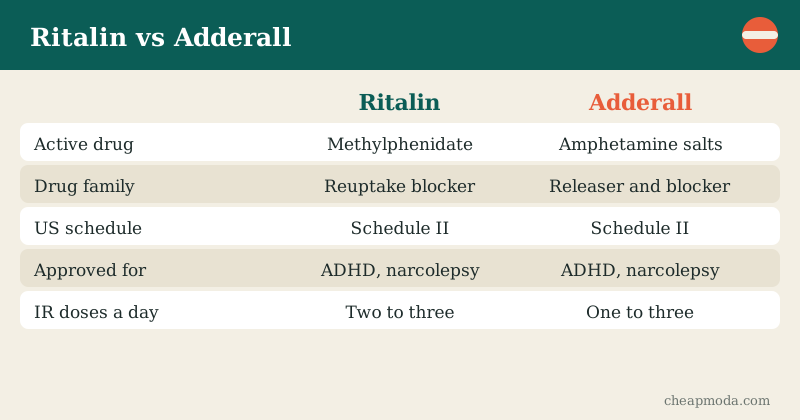
- Ritalin is methylphenidate. It mainly blocks the reuptake of dopamine and norepinephrine, keeping more of them active between nerve cells. It's Schedule II and approved for ADHD and narcolepsy.
- Adderall is a mix of amphetamine salts. Amphetamines block reuptake too, but they also push extra dopamine and norepinephrine out of nerve cells. It's Schedule II, and the immediate-release form is approved for ADHD and narcolepsy.
- Modafinil is a wakefulness-promoting agent with a mechanism that isn't fully understood. It's Schedule IV and approved for narcolepsy, obstructive sleep apnea and shift work disorder. It isn't approved for ADHD.
The one place all three meet is narcolepsy. Outside of that, Ritalin and Adderall are ADHD medicines, and modafinil is a sleep-disorder medicine.
[IMG1]
Side-by-side comparison
| Modafinil (Provigil) | Ritalin | Adderall | |
|---|---|---|---|
| Active ingredient | Modafinil | Methylphenidate hydrochloride | Mixed amphetamine salts |
| Drug family | Wakefulness-promoting agent | Methylphenidate (non-amphetamine stimulant) | Amphetamine |
| US schedule | IV | II | II |
| Approved uses | Narcolepsy, obstructive sleep apnea, shift work disorder | ADHD, narcolepsy | ADHD, narcolepsy (IR); ADHD (XR) |
| Approved for children | No | Yes, for ADHD from age 6 | Yes, for ADHD |
| Immediate-release doses a day | One | Usually two or three | One to three |
| Extended-release versions | Not applicable | Yes, such as Ritalin LA and other methylphenidate products | Adderall XR |
| Boxed warning | No | Yes, abuse, misuse and addiction | Yes, abuse, misuse and addiction |
Two stimulant families and a different kind of drug
Methylphenidate (Ritalin)
Methylphenidate has been used in the United States since the 1950s and is sold under several brand names besides Ritalin, including long-acting forms. The Ritalin label says it's thought to block the reuptake of norepinephrine and dopamine into nerve cells, raising their levels in the space between neurons. It's not an amphetamine and it acts mostly as a blocker rather than a releaser.
Methylphenidate is short-lived in the body. Its half-life is only a few hours, which is why the immediate-release tablets are usually taken two or three times a day. Many people use extended-release versions to avoid midday doses.
Amphetamine (Adderall)
Adderall combines dextroamphetamine and levoamphetamine salts, in roughly a three-to-one ratio. Amphetamines enter nerve cells and cause them to release dopamine and norepinephrine, in addition to blocking reuptake. That's a more forceful push on the same systems Ritalin affects, which helps explain why some people respond better to one family than the other, and why doctors often try the other family if the first doesn't suit someone.
Modafinil
Modafinil is labeled as a wakefulness-promoting agent. Its label notes it binds to the dopamine transporter and inhibits dopamine reuptake, but it doesn't produce the broad release that amphetamines do, and its full mechanism isn't known. In the body it's long-lasting, with an effective half-life of around 15 hours after repeated doses. It's usually taken once in the morning.
What each is approved for
Narcolepsy: the overlap
Narcolepsy is a chronic sleep disorder that causes overwhelming daytime sleepiness and, in some people, sudden muscle weakness called cataplexy. All three drugs have a narcolepsy approval in the US:
- Modafinil for excessive sleepiness from narcolepsy.
- Ritalin for narcolepsy.
- Adderall immediate-release tablets for narcolepsy.
Sleep specialists choose among these and newer narcolepsy drugs based on symptoms, side effects and other health conditions. Modafinil's lower schedule and once-daily dosing often make it an early choice for daytime sleepiness, but that's a clinical decision.
ADHD: Ritalin and Adderall only
Both stimulants are standard ADHD treatments, available in many short- and long-acting forms. Modafinil isn't approved for ADHD. In 2006 an FDA advisory panel voted against a pediatric ADHD version of modafinil, mainly over serious skin reactions seen in child trials, and that version never reached the market. The Provigil label still says modafinil isn't approved for any use in children.
Sleep apnea and shift work: modafinil only
Modafinil is also approved for leftover sleepiness in obstructive sleep apnea when standard treatment, such as CPAP, is already in place, and for excessive sleepiness from shift work disorder. Neither Ritalin nor Adderall is approved for those. Our guide to modafinil for sleep disorders covers those uses in more detail.
What the research says about Ritalin vs Adderall
The most cited comparison is a 2018 network meta-analysis published in The Lancet Psychiatry by Cortese and colleagues. It pooled 133 randomized trials of ADHD medicines. Based on both effectiveness and how well people tolerated the drugs, the authors suggested methylphenidate as the preferred first choice for children and adolescents, and amphetamines for adults. That's a population-level finding. Plenty of people do better on the other family, and guidelines leave room for doctors to switch.
There's no large, high-quality head-to-head trial comparing modafinil with Ritalin and Adderall for the same condition, so claims online that one is "stronger" or "cleaner" across the board aren't backed by solid evidence.
Research on healthy people, such as students without ADHD, is a separate question. Reviews of methylphenidate, amphetamine and modafinil in healthy adults have generally found small, uneven effects on specific tasks like attention or planning, with little evidence of broad gains in learning or grades. Some studies found that people rated their own performance higher on a drug than objective scores supported. That gap between feeling sharper and actually doing better is worth keeping in mind whenever someone describes any of these drugs as a shortcut.
Timing and dosing on the labels
These are labeled ranges for understanding the comparison, not dosing advice.
| Drug | Typical label dosing | Notes |
|---|---|---|
| Modafinil | 200 mg once in the morning (narcolepsy, sleep apnea); 200 mg about an hour before a shift (shift work disorder) | No consistent extra benefit shown above 200 mg in the label |
| Ritalin IR, adults | Divided doses two or three times a day, ideally 30 to 45 minutes before meals; average 20 to 30 mg a day | Some adults need 40 to 60 mg a day, others 10 to 15 mg; the label suggests the last dose before 6 p.m. if sleep is affected |
| Ritalin IR, children 6+ | Start at 5 mg twice a day before breakfast and lunch, raised 5 to 10 mg a week | Daily dose above 60 mg isn't recommended |
| Adderall IR | Started low and raised gradually | Label says it's rarely necessary to exceed 40 mg a day for ADHD; narcolepsy range 5 to 60 mg a day |
Notice how different the scales are. Ten milligrams of Ritalin isn't the same as ten milligrams of Adderall, and neither has a modafinil equivalent.
Side effects
The labels list these among the more common side effects in trials.
| Modafinil | Ritalin | Adderall |
|---|---|---|
| Headache | Nervousness | Loss of appetite |
| Nausea | Trouble sleeping | Trouble sleeping |
| Nervousness, anxiety | Decreased appetite | Stomach pain |
| Runny nose | Stomach ache | Weight loss |
| Back pain | Weight loss in children | Fast heart rate, nervousness |
| Diarrhea, dizziness | Fast heart rate | Dry mouth |
Serious risks
- Misuse and addiction. Ritalin and Adderall carry a boxed warning about abuse, misuse and addiction, updated by the FDA for all prescription stimulants in 2023. Sharing or selling them is a federal crime, and misuse can lead to overdose.
- Heart and blood pressure. Stimulant labels warn about raised blood pressure and heart rate and about serious events in people with heart disease. Modafinil's label also calls for caution in some heart conditions.
- Psychiatric effects. All three labels warn about new or worsening psychiatric symptoms such as anxiety, mania or psychosis.
- Priapism. Methylphenidate products carry a warning about prolonged, painful erections, which the FDA flagged in 2013. Amphetamine labels mention it too.
- Serious rash. Modafinil's label warns about rare, serious skin reactions, including Stevens-Johnson syndrome, and advises stopping at the first sign of a rash unless it's clearly unrelated.
- Contraception. Modafinil can make hormonal birth control less effective while taking it and for a month afterward.
Always read the full medication guide that comes with a prescription.
Prescriptions and the schedule gap
The DEA schedule changes the practical side of each drug.
- Ritalin and Adderall (Schedule II): Refills aren't allowed. Each fill needs a new prescription, though prescribers can write several dated prescriptions covering up to 90 days. Many states add extra rules, like limits on supply or mandatory checks of a prescription monitoring database.
- Modafinil (Schedule IV): Prescriptions can include up to five refills within six months.
Stimulant supply has been uneven in recent years. The FDA announced a shortage of immediate-release Adderall in October 2022 and later listed shortages of some methylphenidate products. If you rely on either, ask your pharmacist about current stock or check the FDA's drug shortages list.
Cost
Generic methylphenidate, generic mixed amphetamine salts and generic modafinil are all sold at US pharmacies, and costs swing widely with insurance, dose, and short- versus long-acting forms. Long-acting brand versions tend to cost the most.
Some people price modafinil from overseas sellers. For context only, Afinil listed ModaXL 200 mg, an Indian generic modafinil from HOF Pharmaceuticals, at $3.99 a tablet for a 10-pack and $1.99 a tablet at 100 when we checked on October 29, 2026. Listed prices can change at any time.
The legal side is simple. Modafinil is a Schedule IV drug and needs a prescription in the US. Buying it from an overseas vendor without one isn't a legal route, those products aren't FDA-reviewed, and customs can seize the package. See our guides on whether buying modafinil is legal and getting a modafinil prescription online.
Quick guide: who tends to be offered what
This is how the three usually line up in practice. Your doctor's advice comes first.
- Children with ADHD: methylphenidate (like Ritalin) or an amphetamine (like Adderall). Not modafinil.
- Adults with ADHD: either stimulant family, chosen based on response, side effects, health history and whether a long-acting form fits better.
- Narcolepsy: modafinil or armodafinil, a stimulant like Ritalin or Adderall, or one of the newer narcolepsy medicines.
- Shift work disorder or sleep apnea with ongoing sleepiness: modafinil or armodafinil.
- Tired or unfocused without a diagnosis: a medical checkup first. Poor sleep, depression, anxiety, thyroid problems and anemia can all look like attention trouble.
If you're also weighing modafinil's close relative, see Nuvigil vs Provigil. For how modafinil stacks up against everyday caffeine, see modafinil vs coffee.
Myths worth clearing up
- "Ritalin isn't a real stimulant." It is. Methylphenidate is a central nervous system stimulant in Schedule II, the same schedule as Adderall, and it carries the same boxed warning about abuse, misuse and addiction.
- "Modafinil is just a milder Adderall." It's a different drug with a different label, different approved uses and a different risk profile, including rare serious skin reactions that the stimulants aren't known for.
- "If one stimulant didn't work, none will." Because methylphenidate and amphetamine act differently, doctors commonly try the other family before concluding stimulants don't help.
- "A higher dose always means better focus." Labels set maximum doses for a reason. Above the right dose for a person, side effects like anxiety, poor sleep and a racing heart tend to rise faster than any benefit.
- "These drugs improve grades for anyone." Studies in healthy people show small and inconsistent effects on thinking tasks, and people often feel more productive than their results show.
- "Long-acting means safer." Extended-release forms change timing, not the core risks. They still carry the same warnings and the same schedule.
The bottom line
Ritalin and Adderall are both Schedule II ADHD stimulants, but they come from different families. Methylphenidate mostly blocks reuptake and is short-acting in its basic form, while amphetamine also releases dopamine and norepinephrine. Modafinil is a once-daily wakefulness drug in a lower schedule, approved for narcolepsy and two other sleep disorders but not for ADHD. All three treat narcolepsy, and that's where the overlap ends. If you're trying to choose, start with the problem you need treated and let a doctor match the drug to it.
FAQ
Is Ritalin weaker than Adderall?
Not in a simple way. They're different drugs dosed on different scales. A large 2018 network meta-analysis in The Lancet Psychiatry suggested methylphenidate as a first choice for children and amphetamines for adults, based on efficacy and tolerability, but individual response varies widely.
Is modafinil a stimulant like Ritalin?
Modafinil is labeled as a wakefulness-promoting agent, not a classic stimulant. It's Schedule IV, while Ritalin and Adderall are Schedule II. It affects dopamine signaling but works differently from methylphenidate and amphetamine.
Can all three treat narcolepsy?
Yes. Ritalin, immediate-release Adderall and modafinil all carry narcolepsy in their US approvals. Modafinil is also approved for obstructive sleep apnea and shift work disorder, while Ritalin and Adderall are also approved for ADHD.
How long does Ritalin last compared with Adderall?
Immediate-release Ritalin is short-acting and is usually taken two or three times a day; methylphenidate's half-life is only a few hours. Immediate-release Adderall usually lasts somewhat longer, and both drugs also come in extended-release versions.
Is modafinil approved for ADHD?
No. It isn't FDA-approved for ADHD, and the Provigil label says it isn't approved for children for any use because of serious rash reports in pediatric trials.
Which of the three is easiest to get?
Modafinil is Schedule IV, so prescriptions can include up to five refills in six months. Ritalin and Adderall are Schedule II, so no refills are allowed and each fill needs a new prescription.
Can I buy modafinil online instead?
Modafinil needs a prescription in the US. Ordering from an overseas pharmacy without one isn't a legal route, and US customs can seize the parcel. A licensed telehealth or in-person doctor is the legal way.