Modafinil and DOT Drug Tests: A Plain Guide for CDL Drivers
 Written by Dr. Marcus Bennett · · Fact-checked October 2026 · How we review
Modafinil isn't one of the drugs a standard DOT drug test looks for. The bigger question for a CDL driver is the DOT physical: you're expected to list your prescription medicines, and the medical examiner decides whether you're safe to drive.
If you drive a truck or bus under a commercial driver's license (CDL), two federal processes affect any medicine you take: the DOT drug test and the DOT physical exam. They're often mixed up, but they work differently, and modafinil sits in each one differently.
This guide walks through both for US drivers who have, or are thinking of asking about, a modafinil prescription. It summarizes public federal rules as of October 2026 from the Department of Transportation and the Federal Motor Carrier Safety Administration (FMCSA). It's not legal or medical advice, and your medical examiner and employer have the final word on your situation.
The short answer
- Drug test: the standard DOT urine test doesn't look for modafinil.
- DOT physical: you should list modafinil as a prescription medicine, and the medical examiner decides whether you're qualified to drive.
- The condition matters: the reason you take modafinil, such as narcolepsy, sleep apnea or shift work disorder, often matters more to certification than the drug itself.
What a DOT drug test checks for
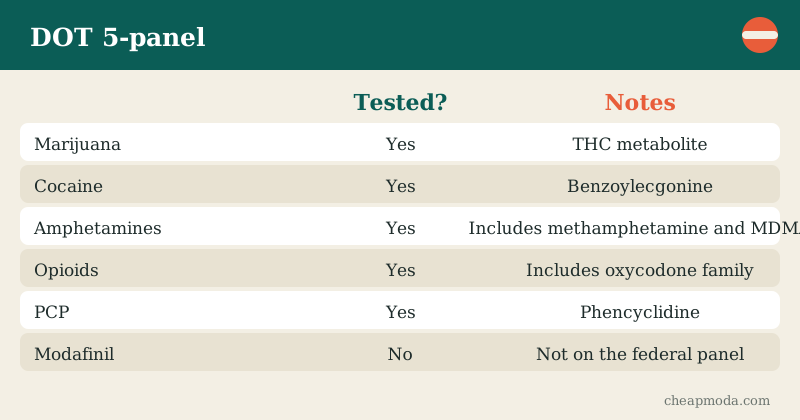
DOT-regulated drug testing follows 49 CFR Part 40. The federal panel is fixed, often called the "5-panel." It covers:
| Drug class | On the DOT panel? |
|---|---|
| Marijuana (THC) | Yes |
| Cocaine | Yes |
| Amphetamines (including methamphetamine, MDMA and MDA) | Yes |
| Opioids (including codeine, morphine, heroin, hydrocodone, hydromorphone, oxycodone, oxymorphone) | Yes |
| Phencyclidine (PCP) | Yes |
| Modafinil or armodafinil | No |
Modafinil isn't an amphetamine. It's chemically different, and it isn't expected to trigger the amphetamine part of a properly confirmed DOT test. DOT labs confirm screening results with a more specific method before anything is reported, which further cuts the chance of a false positive.
DOT rules don't let an employer add extra drugs to a DOT test. Some companies also run their own non-DOT tests under company policy, and those can be broader. If your employer runs one of those, ask HR what it covers.
What about the Medical Review Officer?
Every DOT test result goes through a Medical Review Officer (MRO), a physician who reviews lab results. If something shows up that a prescription explains, the MRO contacts you. Because modafinil isn't on the panel, it normally won't come up at this stage. The MRO can, however, raise a safety concern if they learn you take a medicine that could affect safe driving.
The DOT physical is where modafinil matters
To hold a CDL for interstate driving, you need a valid medical examiner's certificate. That comes from a physical with a medical examiner listed on FMCSA's National Registry.
Before the exam, you fill in a health history on the Medical Examination Report form. It asks about medical conditions, sleep disorders and the prescription medicines you take. You sign that your answers are complete and true. Leaving out a medicine or condition can lead to losing your certificate, and false statements on a federal form carry their own consequences.
What the federal rule says about medicines
FMCSA's physical qualification rules (49 CFR 391.41) say a driver can't use a Schedule I drug, an amphetamine, a narcotic, or other habit-forming drug, unless a licensed medical practitioner who knows the driver's medical history prescribed it and has advised that it won't affect safe driving.
Modafinil is a Schedule IV controlled substance. That's why many examiners ask for a note from your prescriber. A short letter that names the medicine, the dose, the condition it treats, and the prescriber's view on driving safety often makes the exam smoother. The examiner still decides on their own.
Why the condition matters more than the pill
Modafinil is FDA-approved for sleepiness from three conditions: narcolepsy, obstructive sleep apnea and shift work disorder. Each is handled differently at a DOT physical.
| Condition | How examiners typically approach it |
|---|---|
| Obstructive sleep apnea | Common in drivers. Examiners usually want proof of effective treatment, such as CPAP compliance reports. Modafinil may be used for leftover sleepiness once apnea is treated. |
| Shift work disorder | Depends on how sleepy you are and whether treatment works. Expect questions about your schedule and any drowsy driving. |
| Narcolepsy | Treated very cautiously. Many examiners won't certify a driver with narcolepsy, even on treatment. Talk to your sleep doctor and examiner early. |
An examiner may certify you for a shorter period so they can recheck how you're doing. They may also ask for records from your sleep specialist.
Practical steps if you have a prescription
- List it. Put modafinil, the dose, and the prescriber on the health history form.
- Bring records. A prescriber letter and, for sleep apnea, your CPAP usage report.
- Be ready for questions. Expect to be asked about sleepiness, near-misses and drowsy driving.
- Know your timing. If your certificate is close to expiry, give yourself time to gather paperwork.
- Keep it current. If your medicine or condition changes between exams, ask your examiner what you need to report.
Fatigue and trucking: the bigger picture
Drowsy driving is a known risk in commercial transport. Federal hours-of-service rules, ELD logs and required rest breaks all exist because fatigue causes crashes. A medicine that helps wakefulness can be part of treatment for a diagnosed sleep disorder, but it doesn't replace sleep, and it doesn't reset hours-of-service limits.
If you feel heavy sleepiness on the road most days, the most useful next step is usually a sleep evaluation. Untreated sleep apnea is common among drivers and is very treatable. Our shift work sleep disorder explainer covers habits that help night drivers too.
Common myths
"Modafinil will show up as amphetamine." It isn't an amphetamine, and DOT tests confirm screens with a specific lab method before reporting a result.
"If it's not on the test, I don't need to mention it." The drug test and the physical are separate. The physical asks about all prescription medicines.
"DOT bans modafinil." There's no DOT list of banned prescription drugs by name. The examiner decides based on the rules, your condition and your prescriber's input.
The bottom line
For CDL drivers, modafinil isn't part of the DOT drug test, but it is part of the DOT physical conversation. List it honestly, bring your prescriber's details, and expect the examiner to focus on the sleep condition behind it. If you're unsure, call the examiner's office before your appointment and ask what paperwork they want.
FAQ
Does modafinil show up on a DOT drug test?
Not on the standard DOT test. Federal rules in 49 CFR Part 40 test for marijuana, cocaine, amphetamines, opioids and PCP. Modafinil isn't on that list and isn't an amphetamine.
Is modafinil DOT approved?
DOT doesn't approve or ban individual medicines by name. A certified medical examiner decides at your DOT physical whether you're medically qualified to drive while taking a prescribed medicine and with the condition it treats.
Do I have to tell the DOT medical examiner I take modafinil?
The health history form asks about prescription medicines, and you sign that it's complete and true. Leaving a medicine off can put your certificate at risk, so list it and bring your prescriber's details.
Can a truck driver with narcolepsy get a CDL?
Narcolepsy is treated very cautiously in commercial driving. FMCSA guidance leaves the call to the medical examiner, and many examiners won't certify a driver with narcolepsy. Talk to your sleep doctor and examiner before assuming either way.
Can a lab test for modafinil if it wants to?
Yes. A non-DOT employer test or a medical test can look for it, but the federal DOT 5-panel doesn't. Employers can't add drugs to a DOT-regulated test, though they can run separate company tests.
Can I take modafinil to stay awake on long hauls?
Using it without a diagnosis and prescription isn't legal in the US and doesn't fix fatigue. Hours-of-service rules and real sleep are the safety tools. If you're always sleepy, ask a doctor to check for sleep apnea.