Provigil vs Adderall for Narcolepsy: How the Two Compare
 Written by Dr. Marcus Bennett · · Fact-checked November 2026 · How we review
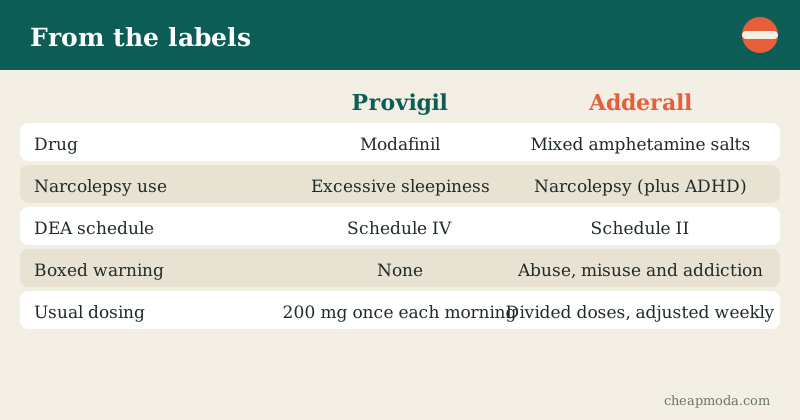
If you've just been told you have narcolepsy, you've probably heard both names: Provigil and Adderall. One gets talked about as a gentler "wakefulness" drug, the other as a classic stimulant. Both are FDA-approved for narcolepsy, and both can help with daytime sleepiness. But they work differently, carry different warnings and are regulated very differently.
This page puts the two side by side using the FDA prescribing information and published sleep-medicine guidance. It isn't medical advice. Only your doctor can weigh your symptoms, other conditions and medicines.
We earn a commission on purchases through our links, at no extra cost to you.
The short answer
- Both are approved for narcolepsy. Provigil (modafinil) is approved to improve wakefulness in adults with excessive sleepiness from narcolepsy, obstructive sleep apnea and shift work disorder. Adderall (mixed amphetamine salts) is approved for ADHD and narcolepsy.
- They're scheduled differently. Provigil is Schedule IV. Adderall is Schedule II, the strictest category for drugs with medical use.
- Adderall has a boxed warning. Its label carries the FDA's strongest warning, for abuse, misuse and addiction. Provigil's label has no boxed warning, though it does carry serious warnings of its own.
- Guidelines lean toward modafinil for sleepiness. The American Academy of Sleep Medicine (AASM) 2021 guideline strongly recommends modafinil for narcolepsy and conditionally recommends dextroamphetamine.
- Cataplexy is a separate question. Neither label is aimed at cataplexy, the sudden muscle weakness many people with narcolepsy have.
What each drug is
Provigil is the brand name for modafinil, made originally by Cephalon. It's a wake-promoting agent, and its exact mechanism isn't fully understood, though the label notes it acts on dopamine reuptake. Generic modafinil has been available in the US for years. Armodafinil (Nuvigil) is a close relative.
Adderall is a mix of four amphetamine salts. Amphetamines are central nervous system stimulants that boost the release of dopamine and norepinephrine. Adderall comes as immediate-release tablets, and Adderall XR is an extended-release capsule. On the labels, the immediate-release tablets list narcolepsy as an indication; Adderall XR is approved for ADHD only.
Side-by-side from the labels
| Provigil (modafinil) | Adderall (amphetamine salts, IR) | |
|---|---|---|
| Narcolepsy approval | Yes, excessive sleepiness | Yes |
| Other approved uses | OSA sleepiness, shift work disorder | ADHD |
| DEA schedule | IV | II |
| Boxed warning | None | Abuse, misuse and addiction |
| Usual narcolepsy dosing | 200 mg once daily in the morning | Start low, raise weekly; total 5 to 60 mg a day in divided doses |
| Pediatric use | Not approved in children | Approved for narcolepsy from age 6 |
| Generic available | Yes | Yes |
That table is a summary. The full labels on DailyMed list every warning, side effect and dosing detail.
How they're dosed for narcolepsy
Provigil: The label's recommended dose for narcolepsy is 200 mg once a day, taken as a single dose in the morning. It notes that doses up to 400 mg a day have been well tolerated, but there's no consistent evidence they work better than 200 mg. Modafinil has a long half-life (around 15 hours in the label's data), which is why it's taken early: a late dose can interfere with night sleep.
Adderall: For narcolepsy, the label suggests starting at 10 mg a day for people 12 and older (5 mg for ages 6 to 12) and increasing by small steps each week until the best response, within a usual range of 5 to 60 mg a day. Doses are split, with the first on waking and others four to six hours apart, avoiding late-evening doses because of insomnia.
So in day-to-day life, Provigil is usually one tablet in the morning, while Adderall is often taken two or three times a day and adjusted more finely.
What the sleep-medicine guidelines say
In 2021 the AASM published a clinical practice guideline on treating central disorders of hypersomnolence, including narcolepsy, in the Journal of Clinical Sleep Medicine. For adults with narcolepsy it gave a strong recommendation for modafinil, pitolisant, sodium oxybate and solriamfetol, and a conditional recommendation for armodafinil, dextroamphetamine and methylphenidate.
Two notes on that:
- The guideline names dextroamphetamine, one of the amphetamines in Adderall, rather than the Adderall brand mix itself.
- "Conditional" doesn't mean "bad." It means the benefit depends more on the individual patient, and many people do well on amphetamines when other options haven't worked.
In practice, a lot of sleep specialists start with modafinil or one of the newer non-amphetamine drugs, and keep amphetamines for when sleepiness is still too much. Your doctor may have a good reason to do it differently.
Side effects and warnings
Provigil: The label's most common side effects include headache, nausea, nervousness, rhinitis, back pain, diarrhea, anxiety, insomnia, dizziness and indigestion. Its serious warnings include rare but dangerous skin rashes (such as Stevens-Johnson syndrome), allergic reactions, psychiatric symptoms and cardiovascular effects. The label says to stop the drug at the first sign of a rash unless it's clearly unrelated.
Adderall: The boxed warning covers high potential for abuse, misuse and addiction, which can lead to overdose and death. Other label warnings include raised blood pressure and heart rate, serious cardiovascular risk in people with heart problems, psychiatric effects, slowed growth in children and circulation problems in fingers and toes. Common side effects include loss of appetite, trouble sleeping, dry mouth and weight loss.
Both labels say that people with a history of heart problems need careful evaluation first. Neither drug is something to start, stop or change without your prescriber.
The cataplexy question
Narcolepsy type 1 includes cataplexy: sudden, brief muscle weakness often triggered by laughter or strong emotion. The Provigil label is about sleepiness, and it doesn't treat cataplexy. Adderall's label is likewise focused on wakefulness.
If you have cataplexy, ask about drugs that are FDA-approved for it in narcolepsy, such as sodium oxybate (Xyrem and related products) and pitolisant (Wakix). Some people use one of those alongside a wake-promoting drug.
Prescriptions, refills and practical hassle
Scheduling affects day-to-day life more than people expect:
- Schedule II (Adderall): prescriptions can't have refills, so you need a new prescription each time (though prescribers can issue several dated prescriptions at once under federal rules). Pharmacies sometimes run short, and some states add extra rules.
- Schedule IV (Provigil): prescriptions can include up to five refills within six months under federal rules.
Many insurance plans need prior authorization for either drug. If you're comparing costs, see our guide to modafinil price with insurance.
Cost
Both drugs have cheap generics in the US. For modafinil, the October 2026 CMS NADAC survey showed US pharmacies paying about $0.35 per generic 200 mg tablet, compared with about $80.25 for brand Provigil 200 mg. That gap is why plans almost always cover the generic first.
Your actual cost depends on your plan's formulary, tier and deductible, and whether you need brand or generic. For cash prices, our page on modafinil cost without insurance goes through the options.
About buying generic Provigil online
We link to Afinil, an overseas store that sells generic modafinil, and we earn a commission if you buy. Be clear on the limits:
- These generics aren't FDA-approved products.
- Modafinil is a Schedule IV controlled substance in the US and needs a valid prescription. Importing without one can break federal and state law, and shipments can be seized.
- Insurance won't pay for imports.
- If you have narcolepsy, a US prescription and pharmacy keep you under a doctor's care, which matters for dose changes and side effects.
Read our legal notes and medical disclaimer before considering it.
How to talk this through with your doctor
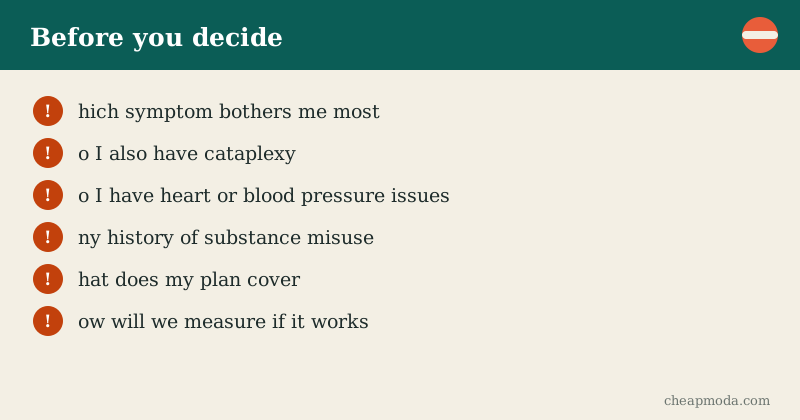
Rather than walking in asking for a specific drug, describe what's actually happening. Useful points:
- How sleepy you are during the day, and when it's worst
- Whether you have cataplexy, sleep paralysis or vivid dreams at sleep onset
- Any heart, blood pressure, psychiatric or substance-use history
- Other medicines you take, including birth control (the Provigil label discusses this)
- What your insurance covers
- How you'll judge whether a medicine is working, for example an Epworth Sleepiness Scale score
Bottom line
Provigil and Adderall are both legitimate, FDA-approved options for narcolepsy. Provigil is a once-a-morning Schedule IV drug with no boxed warning and a strong AASM recommendation. Adderall is a Schedule II stimulant with a boxed warning for abuse and addiction, more flexible dosing and a conditional guideline recommendation via dextroamphetamine. Neither label targets cataplexy. The better choice is the one that controls your symptoms safely, and that decision belongs with your sleep doctor.
FAQ
Is Provigil or Adderall better for narcolepsy?
Neither is best for everyone. Both are FDA-approved for narcolepsy. The American Academy of Sleep Medicine's 2021 guideline gives modafinil a strong recommendation for narcolepsy and dextroamphetamine a conditional one, and many sleep doctors start with modafinil or another non-amphetamine option, but the right choice depends on your symptoms and health history.
Can you take Provigil and Adderall together?
Some people with narcolepsy are prescribed more than one wake-promoting medicine, but only a prescriber should decide that, because combining them can add to side effects such as raised heart rate and blood pressure. Don't combine them on your own.
Does Provigil help cataplexy?
The Provigil label covers excessive sleepiness, not cataplexy. Drugs such as sodium oxybate and pitolisant are FDA-approved for cataplexy in narcolepsy, so cataplexy is worth raising separately with your doctor.
Why is Adderall Schedule II and Provigil Schedule IV?
The DEA schedules drugs by abuse potential and accepted medical use. Amphetamines are Schedule II, which means tighter rules such as no refills on a prescription. Modafinil is Schedule IV, which still requires a prescription but allows limited refills.
Which is cheaper, Provigil or Adderall?
Generic modafinil is inexpensive for US pharmacies, about $0.35 per 200 mg tablet in the October 2026 CMS NADAC survey, and generic amphetamine salts are also widely available as generics. Your insurance tier usually matters more than the list price, so ask your plan about both.
Can I buy Provigil online without a prescription?
In the US, modafinil is a Schedule IV controlled substance and needs a valid prescription. Overseas generics are not FDA-approved and importing them without a prescription can break the law. See our legal notes before considering it.